
Article Publication Date vs Source Record Date: Which Date Are You Reading?
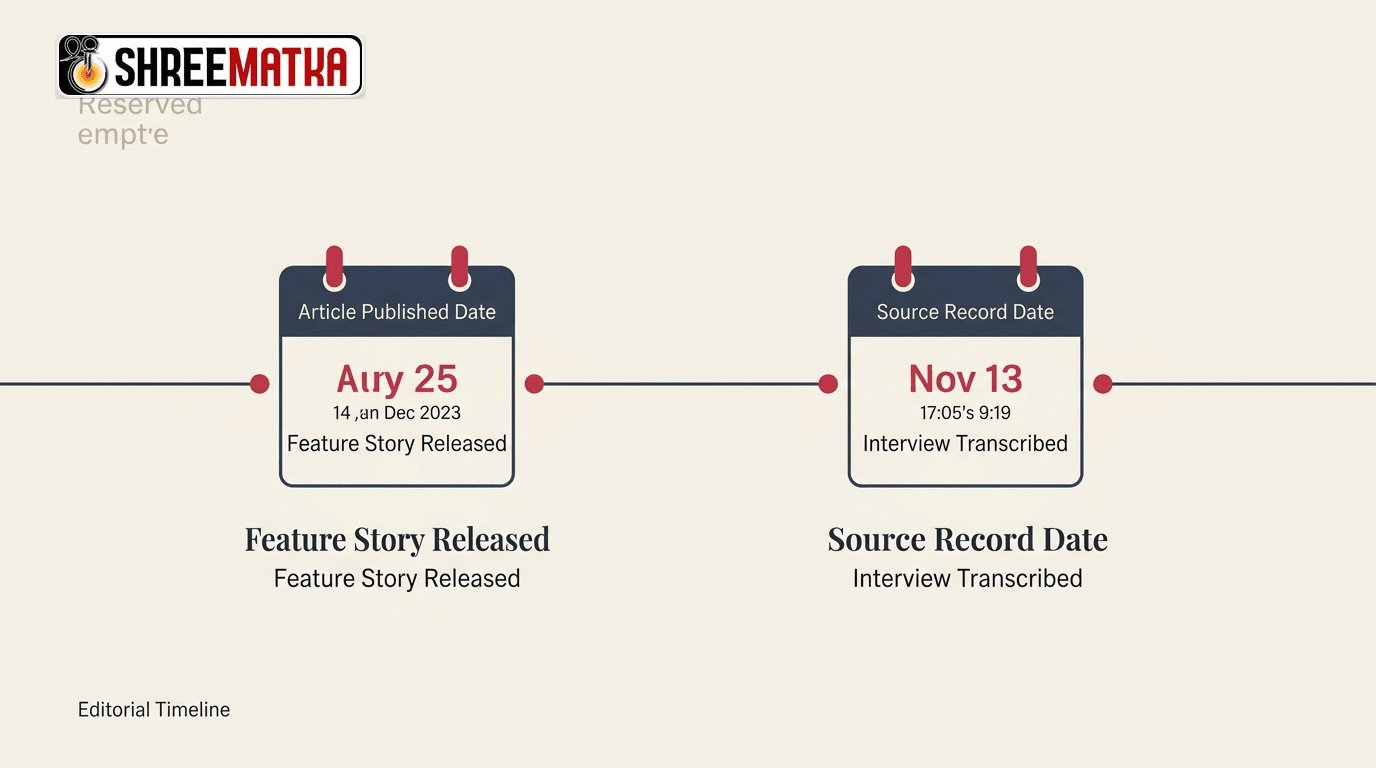
When reading data-heavy informational websites, readers frequently encounter dates in multiple locations on a single page. There is a timestamp beneath the main headline, another date inside an analytical summary table, and perhaps an "Updated" badge in the author byline. When users do not distinguish between the publication date vs record date, significant misunderstandings occur. A reader reviewing an analytical article published today might mistakenly assume that the historical figures quoted inside the text represent today's live results.
In informational journalism and quantitative research, the date a story was written and the date an underlying historical event occurred are two completely independent coordinates.
Failing to separate the container (the article) from the content (the underlying dataset) leads to flawed conclusions. In this guide, we clarify what each date marker represents, how web modification timestamps function, and how to verify exactly which date you are reading.
1. The Three Distinct Timestamps on an Informational Page
A modern web document typically contains three layers of chronological metadata:
┌─────────────────────────────────────────────────────────────┐
│ 1. Article Publication Date                                 │
│    (When the analysis was written and released online)      │
│    e.g., 10 October 2026                                    │
├─────────────────────────────────────────────────────────────┤
│ 2. Document Modification Date                               │
│    (When code, typos, or schema markup were last refreshed) │
│    e.g., 12 October 2026 (dateModified)                     │
├─────────────────────────────────────────────────────────────┤
│ 3. Source Record Date                                       │
│    (When the underlying real-world draw or figure occurred) │
│    e.g., 14 May 2022 (Historical Archive Coordinate)       │
└─────────────────────────────────────────────────────────────┘
1. Article Publication Date (datePublished)
This timestamp records when the author or editorial team finalized the article and made it accessible to the public. It tells you the temporal perspective of the writer. An article published on 10 October 2026 reflects the knowledge, site features, and analytical tools available in October 2026.
2. Document Modification Date (dateModified)
This indicates when a webmaster or automated script last altered the underlying file. If an editor corrects a spelling mistake, updates a broken hyperlink, or refines structured schema markup two weeks after publication, dateModified advances. Crucially, advancing the modification date does not mean that the underlying historical records were refreshed or re-evaluated.
3. Source Record Date
This is the true coordinate of the underlying historical event. If an article analyzes a statistical distribution from the winter of 2021, the source record date belongs to 2021. The fact that the analysis is published in 2026 has zero bearing on the age of the data.
2. Hypothetical Timeline: How the Dates Diverge
To illustrate why these timestamps differ, consider a realistic timeline of how analytical content is researched and published:
| Date | Real-World Event | Corresponding Timestamp |
|---|---|---|
| 15 November 2023 | A regional market declares an unusual consecutive pair sequence. | Source Record Date (2023-11-15) |
| 05 October 2026 | A data analyst extracts the 2023 archive for a probability case study. | Research Phase (Internal) |
| 10 October 2026 | The completed article is published on the blog with an illustrative table. | Publication Date (2026-10-10) |
| 14 October 2026 | An engineer fixes a mobile table styling bug in the template CSS. | Modification Date (2026-10-14) |
If a casual visitor glances only at the header date (10 October 2026) and then looks at the numbers in the body table, they might incorrectly conclude that the figures reflect current October 2026 performance. Checking the column heading or row label inside the table immediately reveals that the figures are archival records from November 2023.
3. How to Identify Which Date Belongs to Which Field
When evaluating a web page containing numeric tables, use this practical checklist to separate the article from its records:
Check 1: Location on the Page
- Under the H1 Title: The date sitting immediately below the main title (often beside the author's name, e.g., "Updated: 10 October 2026") is virtually always the article publication date.
- Inside Table Cells: Dates positioned in the leftmost column of a data grid (e.g., in the ShreeMatka charts directory) are source record dates. Each row represents a specific historical day.
Check 2: Structural Markup (HTML Inspection)
If you inspect the underlying page source using your browser's developer tools, you can examine the explicit machine-readable metadata:
- Look for
<time dateTime="2026-10-10">: This wraps editorial dates for search engines and screen readers. - Look for Schema.org JSON-LD structured data:
{
  "@context": "https://schema.org",
  "@type": "BlogPosting",
  "headline": "Article Publication Date vs Source Record Date",
  "datePublished": "2026-10-10",
  "dateModified": "2026-10-10"
}
The JSON-LD properties datePublished and dateModified describe the web page itself, not the historical entries discussed in the prose.
Check 3: Headings and Table Captions
Reputable informational portals clearly label their tables. A table header reading "Kalyan Annual Summary (2022 Archive)" explicitly signals that the cells below belong to 2022, regardless of when the article hosting the table was uploaded. For details on how archives are cataloged, review the platform's data sourcing policy.
4. Common Misconceptions to Avoid
- "The byline date means all data was collected today." Many articles serve as evergreen guides or retrospective reviews. A guide published today can analyze events from twenty years ago.
- "An updated date guarantees that historical entries were recalculated." Content management systems (CMS) frequently update the visible modification timestamp whenever global templates, header navigation links, or disclaimers are adjusted. An updated timestamp on a webpage does not indicate that the underlying dataset has changed.
- "A chart without a visible year must be from the current year."
Older print sheets and legacy tables frequently abbreviated dates (e.g.,
12-Oct). When reviewing archives, always verify the year from the table masthead or breadcrumb hierarchy before drawing conclusions.
Frequently Asked Questions
1. Why does an article from 2026 discuss results from years earlier?
Informational and educational articles frequently examine historical datasets to study statistical variance, probability patterns, and archival formatting. The publication date reflects when the analysis was written, while the data points reflect historical records from prior years.
2. How can I find the true date of a specific result in a table?
Look at the primary date column within the table itself—typically the first column on the left. The date in that specific row identifies when the numbers were recorded, independent of the article's publication date in the header.
3. What does "dateModified" signify in search engine results?
In search results, Google often displays the dateModified timestamp. This indicates when the web page file or its underlying code was last updated. It does not mean the real-world events described on the page occurred on that date.
4. Can timezone differences change the recorded date of an entry?
Yes. In digital databases, servers operating in UTC may record a timestamp differently than local Indian Standard Time (IST, UTC+5:30). High-integrity archives standardize their display to the local timezone of the market to prevent day-shift confusion.
Disclaimer
Visiting and browsing this website is strictly at your own risk. All information available here is for informational and entertainment purposes only and is based on number calculations. We are not associated or affiliated with any illegal Matka business. We make every effort to follow the rules and regulations of the regions from which the website is accessed. There is a chance the website may be banned in your area; if you continue to use it after that, you alone are responsible for any damage, loss or legal action that may follow. Satta Matka may be illegal in your jurisdiction — please be aware of and comply with your local laws. Gambling can be addictive; players must be 18 or older, and underage gambling is strictly prohibited. If you do not agree with this disclaimer, please leave the website immediately. Copying any content posted on this website is strictly prohibited.