
Complete Beginner's Guide to Satta Matka
Abdul Rahaman is a Full Stack Developer & Marketing Expert specializing in scalable web platforms, digital acquisition, and data analytics.
Complete Beginner's Guide to Satta Matka
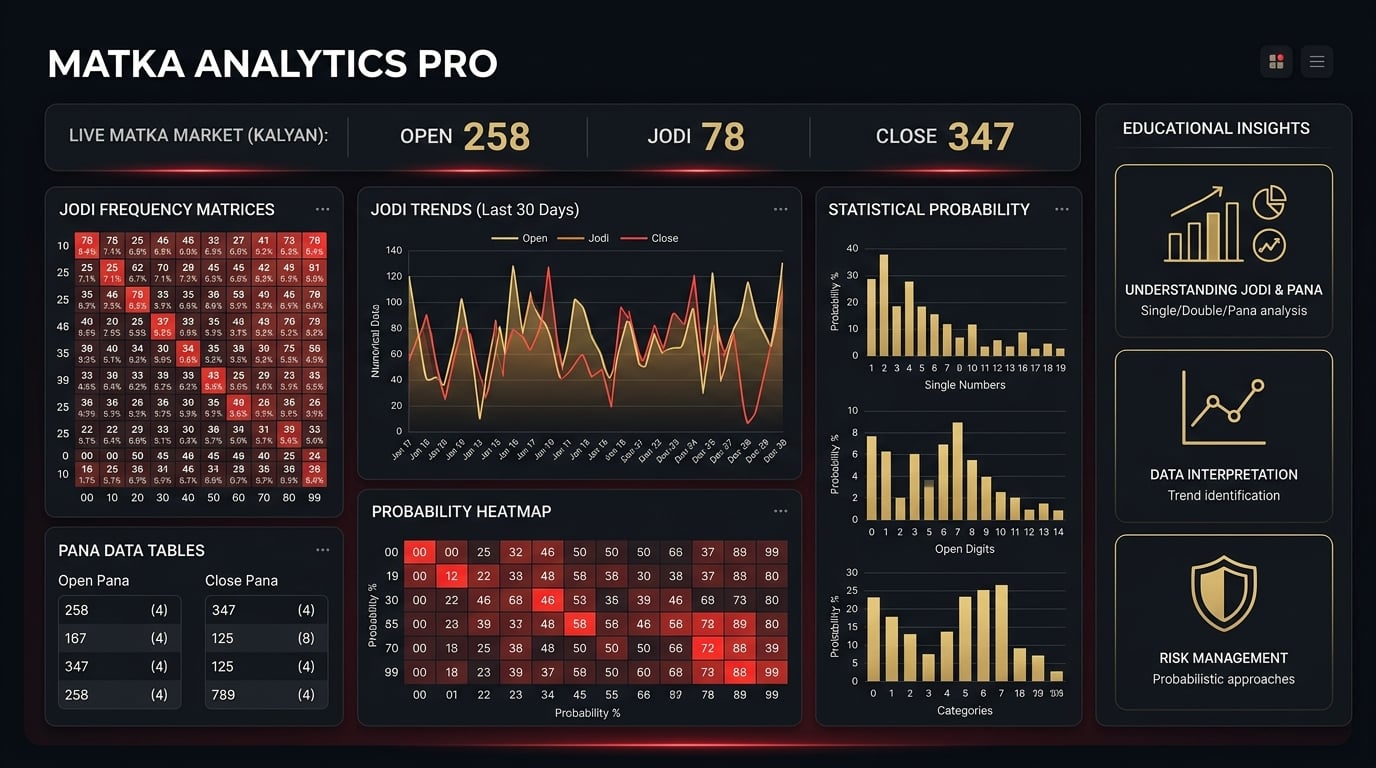
Executive Summary (TL;DR)
- What is Satta Matka? A historical Indian numerical guessing system that has transitioned from physical draws into a high-speed digital analytics ecosystem.
- Core Mechanic: Numbers are generated through three-digit draws (Pana), summed to produce a single-digit outcome (Ank), and combined across morning and evening sessions to form pairs (Jodi).
- Purpose of this Guide: To demystify complex terms like Ank, Jodi, Patti, and Sangam, explain the mathematics behind the draws, and guide beginners on reading charts responsibly.
- Safety & Disclaimer: Matka outcomes are governed by mathematical probability and randomness. Always approach market data with strict discipline and educational awareness.
The world of Indian number-based games has undergone an extraordinary digital transformation over the past decade. What once existed in the bustling lanes of 1960s Mumbai as handwritten slips and clay pots has now evolved into real-time, cloud-synchronized platforms like ShreeMatka.
Yet, for a beginner stepping into this domain for the first time, the terminology can feel like an entirely foreign language. Columns of three-digit figures, hyphenated pairs, "Open" and "Close" timers, and extensive grid charts often leave newcomers perplexed.
This comprehensive guide is designed to dismantle that complexity. Whether you are seeking to understand how mathematical probabilities operate, how to read historical result charts, or how the digital platform processes draws, this handbook provides the exact educational foundation you need.
What Is Satta Matka? Origins & Digital Evolution
To understand Satta Matka today, one must understand where it came from. The word "Satta" translates broadly to speculation or wagering in Hindi, while "Matka" literally refers to a traditional earthen clay pot.
The Historical Roots (1960s)
In the early 1960s, the game originated around the Bombay Cotton Exchange. Punters placed wagers on the opening and closing rates of raw cotton transmitted via teleprinter from the New York Cotton Exchange to Bombay. When the New York Cotton Exchange ceased this practice in 1961, market organizers devised an alternative: drawing random numbered slips of paper out of a large earthen pitcher (Matka).
Over the decades, pioneers such as Kalyanji Bhagat (who introduced Kalyan Matka in 1962) and Ratan Khatri (who established the New Worli Matka) systematized the rules, daily draw frequencies, and payout structures.
The Modern Digital Era
Today, physical pots and handwritten books are relics of the past. Modern users interact with verified online platforms such as ShreeMatka. Digital platforms offer:
- Instant Result Streaming: Real-time updates directly as market declarations occur.
- Historical Data Archives: Multi-year databases of past draws organized into accessible Jodi and Panel charts.
- Data Transparency: Eliminating word-of-mouth discrepancies through cryptographically secured web feeds.
For a structured overview of the basics and app features, explore our How to Play Guide.
The Core Anatomy of a Matka Draw: How Numbers Are Calculated
At first glance, a Matka result string like 258 - 54 - 347 looks cryptic. However, it follows a simple, elegant mathematical formula.
Every full Matka market operates across two distinct daily intervals:
- The Open Session: The opening draw of the market.
- The Close Session: The closing draw of the market.
Let us break down each step using a concrete example.
| Draw Stage | Panel Drawn | Digit Calculation | Declared Element |
|---|---|---|---|
| Open Session | 258 | 2 + 5 + 8 = 15 | Open Ank: 5 (Open Pana: 258) |
| Close Session | 347 | 3 + 4 + 7 = 14 | Close Ank: 4 (Close Pana: 347) |
| Combined Outcome | — | Formed by Open + Close Anks | Jodi Result: 54 (Full Ledger: 258-54-347) |
Step 1: The Three-Digit Draw (Pana / Patti)
In the first phase, three individual numbers between 0 and 9 are selected at random.
- Suppose the three numbers selected are 2, 5, and 8.
- In Matka convention, these three digits are always arranged in ascending numerical order:
258. This three-digit combination is known as the Pana or Patti.
Step 2: Calculating the Sum
The three selected numbers are added together:
💡 Formula / Calculation:
2 + 5 + 8 = 15
Step 3: Determining the Single Digit (Ank)
Only the last digit (unit digit) of the resulting sum is retained:
- From the sum 15, the first digit (1) is discarded, and the last digit (5) is taken.
- This number (5) is called the Open Ank (Single Digit).
- The Open result is formally published as:
258 - 5.
Step 4: The Close Draw
Several hours later, during the evening or closing time of the market, the exact same process is repeated independently.
- Suppose the second set of numbers drawn is 3, 4, and 7.
- Ascending Pana:
347. - Sum: 3 + 4 + 7 = 14.
- The unit digit is 4, which becomes the Close Ank.
- The Close result is recorded as:
4 - 347.
Step 5: Forming the Jodi
When the Open Ank (5) and Close Ank (4) are paired together, they create a two-digit figure: 54. This pair is called the Jodi.
The final record for that day across the market archives displays as:
💡 Formula / Calculation:
258 - 54 - 347
Understanding Different Bet Formats & Variations
In Matka, participants do not simply wager on one general outcome; multiple specialized bet formats exist, catering to varying levels of probability and risk.
| Bet Format | Description | Numerical Range | Probability | Example Selection |
|---|---|---|---|---|
| Single (Ank) | Predicting the final single digit of the Open or Close session. | 0 to 9 (10 possibilities) | 1 in 10 (10%) | Predicting Ank 5 |
| Jodi | Predicting the combined two-digit pair formed by Open + Close. | 00 to 99 (100 possibilities) | 1 in 100 (1%) | Predicting Jodi 54 |
| Single Pana | A 3-digit combination where all three numbers are unique. | e.g., 123, 258, 347 | 1 in 220 | Predicting Pana 258 |
| Double Pana | A 3-digit combination where two digits are identical. | e.g., 112, 335, 448 | 1 in 90 | Predicting Pana 112 |
| Triple Pana | A 3-digit combination where all three digits are identical. | e.g., 000, 111, 777 | 1 in 10 | Predicting Pana 777 |
| Half Sangam | One Open Pana paired with the Close Ank (or Open Ank + Close Pana). | Mixed panel & single | 1 in 2,200 | 258 Pana × 4 Ank |
| Full Sangam | Accurately predicting both the complete Open Pana and Close Pana. | Two full 3-digit panels | 1 in 48,400 | 258 Pana × 347 Pana |
To understand standard market payout ratios and rules in granular detail, visit the How to Play Guide.
How to Read Matka Charts Like an Analyst
One of the most valuable features on ShreeMatka is the historical archive of market charts. To the untrained eye, these look like dense grids of numbers. To a data analyst, they provide historical records of numerical distributions.
There are two primary categories of charts you will encounter on the platform:
1. Jodi Charts
A Jodi Chart records solely the final two-digit result (00 through 99) for each operating day of the week (Monday through Sunday).
- Structure: Columns represent days of the week, while rows represent successive calendar weeks.
- Red Brackets (Red Jodi): Occasionally, you will notice certain cells highlighted in red. A "Red Jodi" occurs when both digits are identical (e.g., 11, 22, 33, 44) or when the two digits are "family cut" pairs (numbers differing by 5, such as 16, 27, 38, 49, 05).
- Check out the historical Kalyan Jodi Chart to see how daily pairs are cataloged over months and years.
2. Panel (Pana) Charts
A Panel Chart is far more detailed than a Jodi Chart. Instead of displaying only the two-digit pair, it displays the complete formula:
💡 Formula / Calculation:
[Open Pana] [Jodi] [Close Pana]
- For instance, Monday's cell might display:
💡 Formula / Calculation:
258 | 54 | 347
- Analysts study Panel charts to observe the frequency with which particular 3-digit groupings appear across distinct seasonal periods.
- You can inspect full historical records on our dedicated Kalyan Pana Chart page.
Explore our centralized Live Matka Charts library to browse panel and jodi records for every major market in India.
Overview of Popular Indian Matka Markets
Not all Matka markets run at the same time. Different markets operate on staggered schedules throughout the day, ensuring continuous updates from morning until late night.
| Market Timing | Market Name | Open Time | Close Time |
|---|---|---|---|
| 09:00 AM – 12:00 PM | Morning Markets (e.g. Kalyan Morning) | 11:00 AM | 12:02 PM |
| 01:00 PM – 02:00 PM | Time Bazar | 01:00 PM | 02:00 PM |
| 03:45 PM – 05:45 PM | Kalyan Matka (Regular) | 03:45 PM | 05:45 PM |
| 09:00 PM – 11:00 PM | Milan Night | 09:00 PM | 11:00 PM |
| 09:30 PM – 11:45 PM | Rajdhani Night | 09:30 PM | 11:45 PM |
- Kalyan Matka: The gold standard of the industry. Founded decades ago, Kalyan Matka remains the most popular market with high data liquidity and consistent declaration schedules.
- Milan Day & Milan Night: Known for dependable time cycles and strong participation among both day and night market followers.
- Rajdhani Day & Rajdhani Night: Established state-level historical markets with stable patterns and highly documented archives.
- Time Bazar: An early afternoon market that frequently sets the tone for daily chart movements.
- Main Ratan: A prestigious evening market with dedicated analytical followings.
Essential Guidelines for Beginners: Analytical & Responsible Habits
Engaging with statistical games requires an educated mindset. While mathematical curiosity and pattern study can be intellectually engaging, it is crucial never to lose sight of reality.
1. Understand the Law of Independent Trials
A common misconception among beginners is the Gambler's Fallacy—the belief that if an Ank like 7 has not appeared in five consecutive days, it is "due" to appear tomorrow. In genuine random draws, every trial is mathematically independent. The probability of any single digit appearing on any given draw remains exactly 10% (1 in 10), regardless of past history.
2. Never Rely on "Guaranteed Fix Number" Scams
The internet is rife with fraudulent operators claiming to possess "100% guaranteed fix leaks" or "direct company leak numbers." These claims are mathematically impossible and fraudulent. Legitimate data hubs like ShreeMatka exist solely to provide verified public results, historical archives, and educational analysis—not fictitious guarantees.
3. Practice Strict Financial Discipline
If you choose to participate in any real-money prediction markets, you must treat it strictly as discretionary entertainment:
- Set a Fixed Budget: Never allocate funds needed for living expenses, savings, or essentials.
- Never Chase Losses: Chasing previous deficits with larger stakes is the fastest path to financial distress.
- Set Time Limits: Do not spend hours glued to live screens. Step away and maintain a balanced lifestyle.
Learn more about our platform standards, editorial independence, and data ethics by visiting our About Us page.
Frequently Asked Questions
What is the difference between Open Ank and Close Ank in Satta Matka?
In Satta Matka, each operating market conducts two draws per day. The Open Ank is the single digit (0 through 9) declared during the market's opening session, calculated as the unit digit of the three opening panel numbers. The Close Ank is the single digit declared at the market's conclusion. Together, the Open Ank and Close Ank form the two-digit Jodi.
How is a Jodi number formed in Matka?
A Jodi is a two-digit combination ranging from 00 to 99. It is formed by joining the single-digit outcome of the Open draw with the single-digit outcome of the Close draw. For example, if the Open Ank is 5 and the Close Ank is 4, the resulting Jodi is 54.
What is the difference between a Jodi Chart and a Panel Chart?
A Jodi Chart displays only the two-digit final outcome (00-99) for each day of the week in a calendar grid. A Panel (Pana) Chart displays both the three-digit opening panel, the two-digit Jodi, and the three-digit closing panel (for example, 258-54-347), offering a deeper view of historical draw combinations.
Can historical Matka charts predict future winning numbers?
No historical chart can guarantee future outcomes. While analysts examine past charts to identify historical frequency distributions and recurring numerical patterns, every draw remains an independent event governed by statistical probability. Historical charts should be utilized for educational context and trend observation rather than definitive forecasting.
Is ShreeMatka a safe and reliable platform to check live results?
Yes. ShreeMatka is built specifically as a high-speed, transparent informational platform. It provides instantaneous live result streaming directly as draws are confirmed, extensive multi-year historical archives, and educational guides to ensure users have access to verified, unmanipulated data without third-party delays.
Disclaimer
Visiting and browsing this website is strictly at your own risk. All information available here is for informational and entertainment purposes only and is based on number calculations. We are not associated or affiliated with any illegal Matka business. We make every effort to follow the rules and regulations of the regions from which the website is accessed. There is a chance the website may be banned in your area; if you continue to use it after that, you alone are responsible for any damage, loss or legal action that may follow. Satta Matka may be illegal in your jurisdiction — please be aware of and comply with your local laws. Gambling can be addictive; players must be 18 or older, and underage gambling is strictly prohibited. If you do not agree with this disclaimer, please leave the website immediately. Copying any content posted on this website is strictly prohibited.