
How Matka Result Archives Are Organized Online
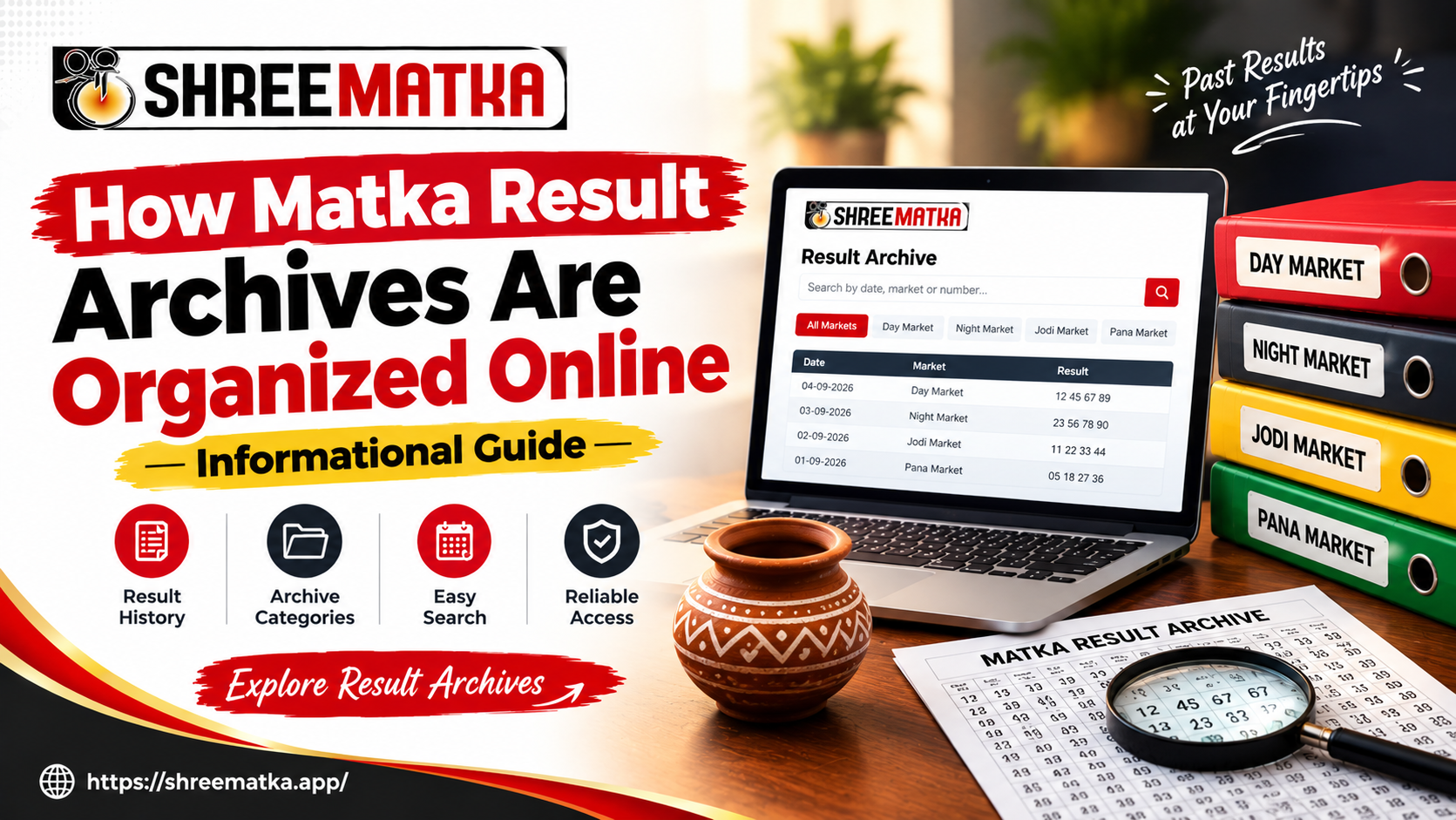
While browsing online results platforms, users are typically confronted by large grids, tables for daily use, and lengthy logs of historical results. Digital Matka outcome archive is an organized archive of earlier results, organized to allow users to search for results that were previously declared through the calendar, date of market and result type.
It can be difficult to navigate these databases and be overwhelming if unaware of how records are indexed. This article explains how result archives online are organized, breaks down typical formats of results and shows how you can look up historical records in a clear manner, and not mistake archives as the use of predictive tools.
What Is a Matka Result Archive?
The Matka result archive is an archive of historical results records. Instead of viewing market results as data updates that vanish after the session has ended, the archive archives each result into the form of an indexable database.
Simple to understand an online archive has a clear hierarchy:
Market Category → Calendar Date → Session Result → Historical Chart Record
The main reason for maintaining an information database is recording. The centralization of the archive lets users verify previous dates as well as understand how information can be organized by market in the course of the course of.
Why Are Matka Results Archived Online?
Websites preserve historical market results to serve a variety of reasons.
- Organised Record Keeping: Storing every day's results in a well-organized database ensures that historical information is kept clear and easily available.
- Convenient Verification: Allows the user to verify numbers declared that are specific to dates from the past either weeks, months, or days.
- Market Comparisons: Allows the reader to discover how market types create their open and closing declarations.
- The Historical Chart Generator: The archives can be inserted directly into tables with visual grids (charts) which makes long-term logs simpler to read.
Archives are merely an information resource. It stores only the events that have already happened but does not have any influence on future developments.
How Are Matka Result Archives Usually Organized?
Platforms online organize the previous entries by using a variety of categories:
- by Date: Group the results chronologically according to either day, month, or the entire year.
- The Market Name is Classifying: Information into market channels that are specific to (e.g., Kalyan or Main Bazar).
- Through Operating Window: Differing from night-time and daytime markets.
- By Results Format: The process of organizing records in specific formats such as Jodi (two-digit) as well as Panna or (three-digit) tables.
Knowing these layers of structure makes finding specific records from the past fast and easy.
Matka Result Archives Organized by Date
Sorting the records according to calendar dates is one of the main functions of every results database. Since different markets release results on a daily basis, indexing by date ensures that entries are not confused.
While searching for a Matka results history based on time, take note of:
- A Full Day Date: Verify the month, day and year of the entry.
- The Market that is Corresponding: Ensure that the date is in line with the market you're examining.
- Complete Session Entry: Check whether the row archived includes both the opening and closing declarations of the specific day.
Always verify both the date and title of the market before using an entry that has been archived.
Matka Result Archives Organized by Market
A Matka archive separated by market provides historic records from a particular market name. While browsing through platforms such as ShreeMatka You will find separate archives of the top markets like:
- Kalyan: One of the market's oldest categories with extensive chart data.
- Milan: Is maintained separately throughout its nighttime and daytime sessions.
- Rajdhani: Dedicated historical logs that are split according to operational timing.
- Mumbai and Main Bazar: Prominent markets with distinctive result archives.
- Time Bazar: A daytime category, with its own organized timeline and log of history.
By separating records according to market name, it makes sure that the results of the same category do not overlap with the other.
How Day and Night Markets Appear in Archives
The markets that are operating during the daytime are logged independently from markets operating at night. This difference is apparent by the method in which archives organize their log entries.
| Archive Feature | Day Market | Night Market |
|---|---|---|
| Market Category | The operating hours for the daytime | Evening/Night operating window |
| Historical Records | Tables used for the daytime. | Maintained tables at night. |
| Date Indexing | Connected to the daytime calendar session | It is linked to the evening's calendar session |
| Market Identity | Included are "Day" or daytime labels | Incorporates "Night" or evening labels |
| Chart Archives | Accessible on specific Day charts | Charts for Night viewing |
Separating archives for night and day separated ensures that the timing distinctions are clearly visible and the historical records are kept in order.
Monthly and Yearly Matka Result Archives
To store long-term data, databases combine daily data into tables for yearly or monthly records.
- Monthly Archives: Combine the daily results from the first day to the close of a particular month in a single, accessible grid.
- Archive Yearly: Stack table tables for the month in chronological order so that readers can look at earlier historical records that go back multiple years.
This extended archive makes it possible to find earlier figures without having to navigate through hundreds of different results pages per day.
How Matka Charts Fit Into Result Archives
Although the two terms are frequently employed interchangeably, the terms result archive as well as a Matka chart are two distinct terms:
- Results Archive: The complete base database which stores the past entries for the years and across markets.
- Matka Chart : A particular grid table or visual display which displays a specific part of stored data (e.g. for example, a four-week Kalyan Jodi graph).
Charts draw their raw numbers directly from the archive of results by displaying closed numbers, open figures, Jodi pairs, as well as Panna sets in a simple-to-read table.
Common Result Formats Found in Historical Archives
If you look through archived records you'll come across a variety of standard entries:
Open Result
The number of the initial number of figures announced in the beginning of the market's operating window.
Close Result
The final number, or set of figures announced after the close of an operational market.
Jodi
A figure with two digits created through the combination of the digits that resulted from the session.
Panna / Patti
Three-digit combination sets are announced in the closing or open phase of a trading session.
Knowing these terms will help to navigate tables from the past with precision.
How to Find a Previous Matka Result in an Online Archive
The process of finding a particular record on an electronic database requires only two steps:
1.Navigate to the Archive Section:
Use the result history section or the chart section of the platform.
2.Select the Exact Market:
Select the market's specific title (e.g., Milan Day or Rajdhani Night) from the directory.
3.Specify the Date or Range:
You can filter the information by choosing the day, month or the year.
4.Confirm Day/Night Classification:
Check that you've chosen the right operational window for market pairs.
5.Review the Record Row:
Review the entry you see and confirm that the market title, date and Close/Open figures are in line with your search.
How to Read a Historical Matka Result Table
Tables that are archived organize session data in simple columns and rows. Below is an example the way a typical historical result row will be structured:
| Date | Market Name | Open Result | Close Result | Jodi | Panna / Patti |
|---|---|---|---|---|---|
| DD/MM/YYYY | Market Identifier | Open Figures | Close Figures | 2-Digit Pair | 3-Digit Sets |
A row read in order from right to left permits one to check that the date is correct then confirm the name of the market before reviewing the numbers that are declared for this session.
Current Matka Results vs Historical Result Archives
It is essential to differentiate between live update results and databases that have been archived.
| Feature | Current Results | Historical Result Archives |
|---|---|---|
| Primary Purpose | Show recent or current declarations | Past entries in the store that have been completed for future reference |
| Time Period | The session today is active | Older calendar dates and yesterday |
| Update Frequency | Live updates during the market hours | Permanent, static, and fixed forever after being logged |
| Main Function | Gives instant updates on the current situation. | As a reference for information, it serves as a database |
Why Accurate Dates and Market Names Matter
While reading databases from archives minor mistakes could result in incorrect information. Common errors include:
- Confusion of similar market titles Confusion of similar market titles: Mistaking a daytime event as a nighttime one (e.g. Checking Milan Night instead of Milan Day).
- Incorrectly interpreting dates: Missing the month or year when looking through old historical records.
- Switching Result Columns: reading an open figure as Close because of a lack of familiarity with column tables.
Checking header information on each chart page can prevent this kind of error.
Can Matka Result Archives Predict Future Results?
One of the most common misconceptions among newcomers is that looking through historical records will reveal formulas and assurances for the future of outcomes.
It is crucial to know the following:
- Archives are Retrospective: Historical documents document the events that have already occurred. They do not have any mathematical authority over the future.
- Sessions are Independent: Each market session begins as a new trial. Previous numbers are not a reason to create future results "due" or more likely to occur.
- The patterns that appear in figures: In archives occur in every random data set, and are not proof of a predetermined code.
An archive used as an old-fashioned dictionary is useful but using it to create an actual crystal ball is a misunderstanding of the way that probability is a process.
Common Mistakes When Using Matka Result Archives
Make sure you avoid these mistakes common to beginners while navigating databases online:
- One mistake: treating old Records as current updates. Make sure to verify that the date of the calendar is on the top of the table.
- The second error is cross-referencing unrelated Markets Kalyan's results Kalyan do not have any connection to the results of Rajdhani as well as Milan.
-
- Believing that there are "Due" Numbers The assumption that a missing digit will be appearing soon ignores the most basic principles of probability.
- Fourth error: relying on untested databases -- Make sure you use clear, well-organized platforms to make sure that historical data and entries are correct.
Matka Result Archives on ShreeMatka
Being able to find clear, correctly indexed data from the past is vital to make it easy to reference. With ShreeMatka the historical results are organized according to names of markets, dates as well as chart categories which makes navigation simple for users.
It is possible to explore different pages on the website that include:
- Live news and updates about ShreeMatka Matka's results
- Complete Matka Charts for the major markets
- Dedicated Jodi charts and Pana charts
- Informational articles on our ShreeMatka guide blog
Conclusion
Online Matka result archives are structured digital libraries that provide results from the past. Through categorizing entries in clear terms in terms of date, market name and operating window the databases let users find past results easily.
Recognizing that archives are only historical reference tools allows one to explore historical charts in a clear and confident manner. Find organized databases, as well as instructional guidelines directly through ShreeMatka..
Frequently Asked Questions
1.What exactly is a Matka results archive?
The Matka results archive can be described as a digital library that archives previous results in chronological order according to date, name of market and format of the result to be used for reference in the past.
2.What is the way Matka Results are organized online?
Online archives classify entries with various layers. These include dates on the calendar, categories for market operating timing (day day vs. night) as well as chart layout.
3.Where can I locate earlier Matka results on the date?
Yes. Many result databases allow users to browse through logs from the past through the selection of a specific date and month or even a year.
4.What's the main difference between a Matka chart and an archive of results?
A result archive is a full database of all historical entries and a Matka chart can be described as a visual table which displays just a small portion of this information.
5.Do past Matka performance be a guide to future results?
No. Archives only record the outcomes of past events. Since each market session functions independently, archives do not guarantee or predict any future outcomes.
Responsible and Legal Information
Matka is a form of real-money betting with inherent financial risks. The laws and regulations governing gambling vary dramatically across various States and across countries.
Every reader should
- Follow the local laws in force and regulations regarding age (18or older in the majority of areas).
- It is important to recognize the fact Matka is a completely random game of luck with no guaranteed results.
- Do not consider historical archives an opportunity to develop financial strategies or investment strategies.
The database's entries from the past as well as charts and other educational content on this website are intended to be used for reference purposes only.
Disclaimer
Visiting and browsing this website is strictly at your own risk. All information available here is for informational and entertainment purposes only and is based on number calculations. We are not associated or affiliated with any illegal Matka business. We make every effort to follow the rules and regulations of the regions from which the website is accessed. There is a chance the website may be banned in your area; if you continue to use it after that, you alone are responsible for any damage, loss or legal action that may follow. Satta Matka may be illegal in your jurisdiction — please be aware of and comply with your local laws. Gambling can be addictive; players must be 18 or older, and underage gambling is strictly prohibited. If you do not agree with this disclaimer, please leave the website immediately. Copying any content posted on this website is strictly prohibited.