
Matka Number Patterns: Difference Between Observation and Prediction
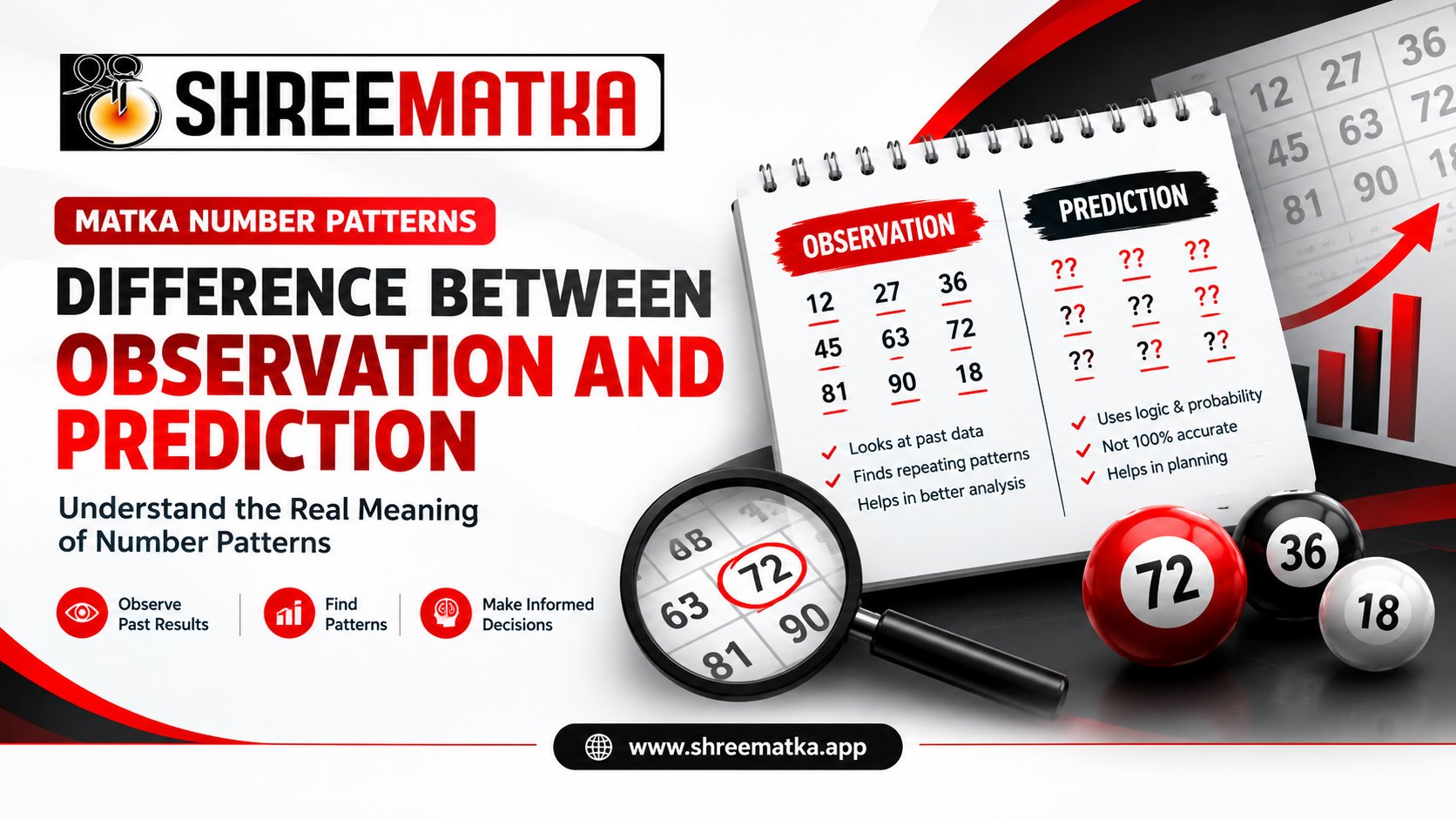
As new players begin exploring the archives of Matka result history and chart data records, one of their first discoveries is likely to be the presence of patterns in the numbers. It is possible to open a weekly chart and find a particular digit repeated three times in a row, an Open and Close pair that appears after a certain span of time, or a certain number that seems to never appear.
It is only natural that a viewer would examine these formations and wonder what they signify, if they contain any predictive value, or if they can be used to determine what numbers are likely to appear next.
While it is human nature to seek patterns, new players must understand the difference between observation and prediction when dealing with historical records
What Are Matka Number Patterns?
Depending on what players discover, a description of the arrangement they see can fall under several categories. In most charts that span days or weeks, it is possible to find repeated digits in Open or Close positions, repeated Jodi, Panna, or Patti, gaps of missed digits, ascending/descending digits, or numbers that begin to appear with greater frequency over a given period of time. All of the above are considered patterns, as they show some sort of consistency or frequency of occurrence
However, the presence of any such formations does not signify that they contain any special meaning, predictive value, or internal logic. To put it simply and objectively, a pattern is merely an observed trait of a set of numbers no matter how frequently it appears, it still only reflects history.
What Is Observation in Historical Matka Data?
In scientific fields, an observation is defined as a note or record of something that has already occurred that can be verified by examining the source of information. This definition applies to any notes or comments about a Matka result sheet before attempting to interpret it or use it for purposes of prediction. A simple statement of fact, such as “digit 7 has appeared in the Open position four times this month,” is an example of an observation. Observations are always made in reference to historical data what has already occurred.
Some general properties of observations include:
- They are always made with reference to something that has already happened
- They can be verified by anyone who has access to the same information
- They describe facts, not guesses or predictions
Observations made in reference to a Matka chart are a great way to become familiar with how they are put together and what digits and combinations have appeared. The problem occurs when an observer attempts to turn an observation into a prediction or uses it as a basis for one.
What Is Prediction?
In scientific fields, a prediction is defined as an estimate or forecast of something that has not yet occurred or happened. Predictions are essentially guesses about the future; however, they may sometimes be based on sound observations and principles of mathematics or science. In essence, a prediction is always an assumption about what might happen next based on information known about what has already happened. When it comes to Matka charts and their analysis, a prediction occurs when a player tries to use the information found in a historical sheet to estimate what numbers are likely to appear.
A critical thing to understand about predictions and their accuracy is that a prediction is always just a guess about something that has not yet happened. Even when an accurate description of a historical pattern is used as a basis for making a prediction, it does not change the fact that a prediction is inherently uncertain and imprecise. To better understand the limitations of using historical data for result prediction, students are encouraged to review our guide on whether historical Matka data can predict future results.
Observation vs Prediction: What Is the Difference?
To keep the two concepts straight, it is helpful to make a list of properties that they each share and how they differ.
| Concept | Property | Observation | Prediction |
|---|---|---|---|
| Time focus | Looks at the time perspective | Looks back at historical data | Looks ahead at something that has not yet happened |
| Verifiability | When it can be checked | Can be verified using historical records | Can only be verified once the event it describes has occurred |
| Certainty | Level of certainty | Is completely certain | Is always an estimate or guess |
| What it does | Purpose | Describes something that has already happened | Describes something that has not yet happened |
Confusion between observations and predictions is one of the primary ways that new players can be misled into believing that they know something about a future result when they do not. An observation only describes something that has already happened it cannot say anything about what will happen in the future.
Why Do People See Patterns in Random Data?
There are sound psychological reasons why people begin to think that there are hidden rules and patterns behind chance events or random occurrences. The human brain is very good at finding ways to categorize things, and whenever a person encounters something that does not fit into a known category, they will usually take measures to update their mental framework to include it. A useful way to think about this process is the way that constellations were discovered.
It is well-known that the stars in the night sky are massive spheres of plasma at millions of degrees; however, that was not always the case. Ancient astronomers and stargazers would look up at the sky and see points of light that did not appear to have any order or organization to them. To make sense of what they were seeing, they began connecting the dots — literally. By drawing lines between these points of light, they were able to give meaning to seemingly meaningless sky patterns and discover celestial objects like bears, hunters, and tides.
In the same way that constellations are patterns of stars that only exist in the eyes of observers, any pattern seen in a Matka chart is an attempt to ascribe meaning or organization to something completely random. Understanding that historical data about results only reflects what has already happened is crucial to distinguishing between things that are true and things that are only believed to be true. To learn more about randomness and Matka results, students are encouraged to review our guide on understanding randomness in Matka results.
Also Read: Safe Online Matka Guide: Secure Access to ShreeMatka
Common Matka Number Pattern Myths
One of the biggest problems with confusing observations with predictions is that it leads people to believe things that are not true or have no basis in logic or mathematics. Believing that historical patterns dictate future results means believing in several misleading myths about how Matka results work.
| Myth | Reality |
|---|---|
| A number that appeared frequently must appear again | A high frequency of appearance in the past does not change the odds of a number appearing in the future |
| A number that has not appeared must appear soon | A long absence of a number in Matka history does not mean that it has a higher chance of appearing in the future |
| Something that happened in the past will happen again in the future | There is no basis for assuming that a pattern seen in the past will dictate results in the future |
| Having more data gives better results | More data provides more information about the past, not the future |
| Every pattern has a hidden explanation | Many patterns will appear in a large enough set of data purely by chance |
Examples of Observation Without Prediction
To better understand the difference between observing historical results and making predictions, consider the following examples:
| Example | Observation / Fact | Prediction / Unwarranted Claim |
|---|---|---|
| Example 1 | Fact: "Digit 4 was the Open number on three consecutive days." | Unwarranted claim: "Digit 4 is on a streak and will appear tomorrow." |
| Example 2 | Fact: "Jodi 52 has not appeared in this market for 60 days." | Unwarranted claim: "Jodi 52 is overdue and guaranteed to show up." |
| Example 3 | Fact: "The Open result followed an odd-even-odd sequence." | Unwarranted claim: "The next Open result must be an even number." |
In the three examples above, the statements that begin with • Fact: are observations — they describe known facts about what has already happened. The statements that begin with • Unwarranted claim: attempt to make predictions about the future based on observations. Anyone hoping to learn how to read a Matka chart properly must understand the difference between these two types of statements.
Historical Frequency vs Future Probability
Another common confusion that new players make is to conflate the concepts of historical frequency and future probability.
Historical frequency refers to how often something occurred in a body of data. Because this measurement is taken from actual, verifiable history, it is always a precise quantity. If a single digit has occurred 15 times out of 100 in a given set of results, then its historical frequency is 15% in that data set. Future probability refers to the chance that something will occur in the future. Since this is a projection, it is not a precise number. It refers to a possibility, not a certainty. The two concepts are often confused, even though they refer to completely different ideas. Mixing up these two concepts is a common way to reach false conclusions about the behavior of the results or fall victim to scams that promise guaranteed returns.
How Beginners Should Read Matka Charts
Reviewing historical results can be an interesting and educational way to pass time, gain exposure to data, and learn more about how probability theory works. However, to be responsible and respectful when interacting with any Matka chart data, there are some guidelines that players should follow.
- View charts purely as historical references: When interacting with any historical data, it is important to remember that it only has value as a record of what has already happened.
- Verify dates and markets: Never assume that a given set of results belongs to a particular market or has occurred at a specific time; make sure to double-check the metadata before using it for any purpose.
- Differentiate between facts and assumptions: When examining a chart, it is easy to confuse what is known about the past and what might happen in the future. Make sure to treat the two sets of information as completely separate.
- Avoid "fixed number" scams: Be wary of websites, organizations, or individuals that claim to have access to "fixed numbers," "sure-shot predictions," or any other method for guaranteeing a return on investment at Matka. Anyone who engages in or promotes these types of dishonest and predatory behaviors should be reported to the proper authorities.
- Prioritize privacy and data safety: To be safe, always make sure that you understand the general privacy policy that any Matka-related website publishes for its users.
- Examine mobile and desktop website differences: Whether using a mobile website or an application, always be aware of significant differences between the two platforms' general UI/UX and accessibility.
- Follow local laws and regulations: As with all forms of gambling or wagering, Matka is illegal in many jurisdictions. Players should make sure to follow laws and regulations in their area regarding Matka engagement and online gambling.
How ShreeMatka Helps Users Understand Historical Results
At ShreeMatka, we value the importance of providing accurate and reliable historical data to our players and users. We strive to make our archives of historical results as easily accessible and easy-to-use as possible for all users, whether viewing on a computer, accessing the mobile site, or using a dedicated application.
Understanding how results are reported is an important step in learning how to read a Matka chart, and we have published a guide to online Matka result pages that explains some of the ways that different platforms choose to display the data. Additionally, we have a comprehensive resource on historical Matka data that covers some of the nuances of reviewing large bodies of information. We do not guarantee any results or outcomes, provide any "sure-shot" predictions, or engage in any unethical or predatory practices.
Conclusion
The analysis of Matka number patterns can be greatly optimized by treating observation and prediction charts differently, considering that the former can highlight repetitions, gaps, frequencies, or other patterns, but not necessarily indicate future occurrences with certainty.
In this regard, it is advisable for those new to the concept to approach the charts with a critical mind, considering historical results as mere records rather than performance indicators or guarantees. To minimize the possibility of acquiring false or exaggerated information on guaranteed results, one should pay attention to dates, understand chart mechanics, distinguish between subjective and objective data, and avoid unsubstantiated and overconfident claims.
Overall, the patterns should be used as a source of inspiration and an exercise in observation rather than a reliable guide to fixed numbers or outcomes. In this regard, a profound knowledge and understanding of the game’s basics, history, regulations, and randomness are more likely to benefit a player in the long term rather than relying on perceived patterns and their implications.
Frequently Asked Questions
1. What are Matka number patterns?
Matka number patterns refer to any consistent or recurring visual or mathematical formation that can be observed in the results of past Matka games. They can be seen in any combination of repeated digits, frequency changes, or the appearance of certain combinations more frequently than others.
2. Can historical Matka patterns predict future results?
No, they cannot. Any consistent or recurrent pattern only reflects the history of the results; it has no bearing on what future results might look like.
3. What is the main difference between observation and prediction?
Observations refer to statements of fact about things that have already happened, while predictions are guesses about things that might happen in the future.
4. Does a repeated Matka pattern mean it will happen again?
Not necessarily. While repetitions in patterned data might suggest that something happens frequently, they do not dictate that it will continue to happen. Future results are not determined by past results.
5. Can beginners use historical Matka charts to understand past results?
Yes, they can and should. Charts are useful learning tools that allow users to examine how historical results are organized, what digits or combinations have appeared, and how frequently they occurred.
Disclaimer
Visiting and browsing this website is strictly at your own risk. All information available here is for informational and entertainment purposes only and is based on number calculations. We are not associated or affiliated with any illegal Matka business. We make every effort to follow the rules and regulations of the regions from which the website is accessed. There is a chance the website may be banned in your area; if you continue to use it after that, you alone are responsible for any damage, loss or legal action that may follow. Satta Matka may be illegal in your jurisdiction — please be aware of and comply with your local laws. Gambling can be addictive; players must be 18 or older, and underage gambling is strictly prohibited. If you do not agree with this disclaimer, please leave the website immediately. Copying any content posted on this website is strictly prohibited.