
What Do Matka Numbers Actually Mean? A Simple Explanation
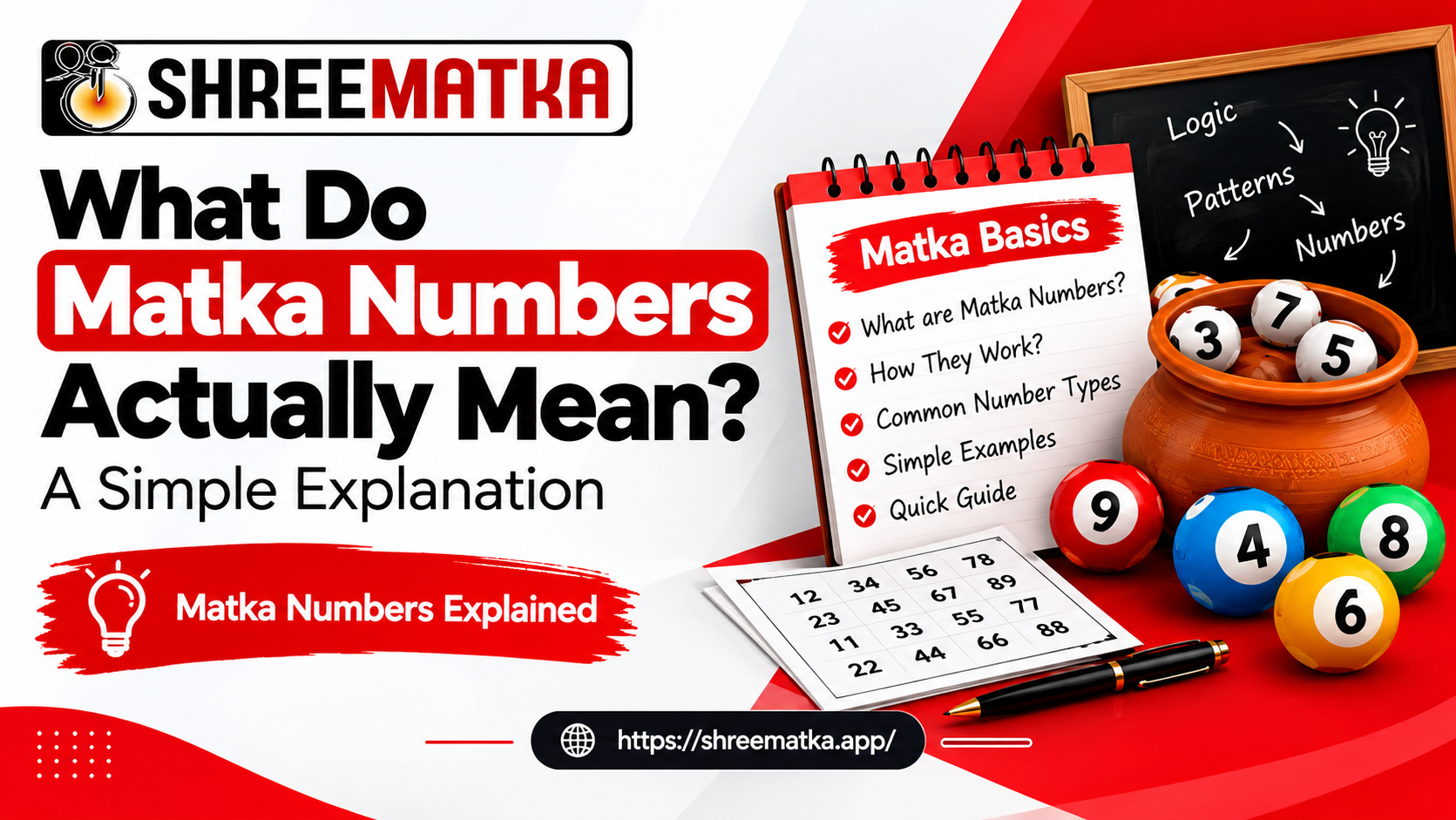
If not contextualized, a 3-digit number or a pair of two numbers could appear to be a random code. The online pages for results are consistent in their formatting. When you understand how numbers are arranged and read, understanding the data on a display board becomes easy.
This guide for beginners explains the meaning behind "Matka numbers" actually represent and why they are displayed on boards online, the best way to understand them with regard to dates and categories, as well as the best way to handle historical data in a responsible manner.
What Does "Matka Number" Mean?
For websites that offer results The term Matka number is used to refer to a numerically published entry connected to a particular date, session in the market, as well as draw phase.
Core Concepts for Beginners
- Published Record: The term “published record” refers to a Matka number presented as a data point on a computer screen in connection with a pre-planned draw window.
- Context-Dependent Entry: The number by itself has no inherent meaning. Its meaning is determined by the context of its category (e.g., Kalyan, Milan Day), session stage (e.g., Open or Close), and calendar date.
- Informational Resource: Websites record these numbers in structured tables, allowing users to review previous and current entries for informational reference.
Why Are Numbers Shown on Online Result Pages?
The online result platforms provide numbers to keep clear, organized, and easy to read historical records.
- Information Organization: The presentation of information in a uniform string of numbers helps users to browse through multiple sessions simultaneously on a single screen.
- Historical Logging: Archiving publicly published numbers allows platforms to create chronological libraries that cover the past months, weeks, and even years.
- Date-Wise Indexing: Associating numeric entries with calendar dates, you can create a clear timeline that prevents old information from being misinterpreted as current versions.
- Categories Distinction: Showing the entries with certain market categories prevents confusion in cross-categories between market types, whether timed or regional.
Understanding Different Types of Numbers on a Result Page
If you are looking at an online results board, each number is the same kind of information. For beginners, it is important to differentiate three distinct elements of numbers:
-
Date and Time Values The numbers that represent the calendar's days, months, year, or timestamps (e.g. 02/09/2026, or 03:30 pm).
-
Market category identifiers numbers or numbers used to identify particular market events or operating windows.
-
Actual numbers published for a particular session. These typically appear as clusters formatted in a manner for example:
-
Single Digits: Individual numbers that range from 0-9.
-
2-Digit Pairings (Jodi) Double-digit numbers that represent values combined (e.g. 45 or 78).
-
Three-Digit Sets (Pana or Panel) three-digit sets that are released during closed or open sessions (e.g. 456, 123 or 456).
How to Read a Number in Context
A number that is read without taking a look at the surrounding context of it is the most common source of confusion for novices. Use this scanning technique when looking at the result pages on ShreeMatka.app:
Step 1: Examine the Header of the Page: Confirm the Domain as well as the section.
Verify that you're at the right page or in the appropriate platform category.
Step 2: Check that the Date is correct: Check the calendar date and year.
Find the heading for the date above or under the table in order to determine the date that the entry is applicable to.
Step 3: Define the category: Identify the market board.
Look up the section's title (e.g., Kalyan, Time Bazar, Rajdhani) to verify the market you're looking at.
Step 4 Learn to read the Table Column headings: Learn about column function.
Check the top head row of the table to determine if a column is for open, Jodi Close, or Open entries.
Step 5: Find the specific entry: align row and column.
You can follow the row of the date you want to target across the column cell that is corresponding for the entry to be read.
Step 6: Review Information Status: Differentiate live from the past reports.
Make sure the entry you are looking at is a living update, or an archived log.
Simple Example of a Result Table
For a better understanding of how these components are connected, take a look at the example table in the following.
| Date Header | Category Label | Three-Digit Open | Two-Digit Combination | Three-Digit Close | Entry Status |
|---|---|---|---|---|---|
| 01/09/2026 | Sample Market A | 123 | 67 | 456 | Archived Record |
| 02/09/2026 | Sample Market A | 234 | 89 | 567 | Archived Record |
| 03/09/2026 | Sample Market A | 345 | 90 | 678 | Archived Record |
| 04/09/2026 | Sample Market A | *** | ** | *** | Pending / Active Day |
Notice: The table below is purely fictional and serves solely as a teaching tool to help explain the table's formatting.
Explaining the Layout
- Date Header: Describes which day on the calendar that the row records.
- Three-Digit Open/Close: Reflects three-digit set numbers published during the close and open sessions.
- Two-Digit Combination: Displays a two-digit number that represents the middle value.
- Placeholders: indicate the session is in progress and scheduled to run at a later time or suspended for an event like a day of celebration.
What Is the Difference Between a Number and a Result?
Beginning students often employ the terms "number" and "result" in a similar way, however they are referring to distinct terms:
- Number: The word “number” refers to an independent numerical value that has mathematical significance, such as 7 or 123. By itself, a number does not provide any specific context regarding a market, price, session, date, or time.
- The Result: A fully authentic, validated data entry that includes a particular market segment, the date of the calendar, session phase (open/close) as well as its associated numerical numbers that are published.
A number is merely one of the components; what it produces is a complete, context-specific record.
How Dates and Numbers Work Together
An arbitrary number can be meaningless without the date. Digital platforms depend on strict dates for a variety of reasons.
- Avoids confusion between old entries and new ones: A newly released digit that was published two weeks ago appears similar to one released today. Date stamps are the sole thing that differentiates the two.
- Organises Historical Archives: Grouping entries in specific weekly, daily or monthly blocks of dates lets users navigate through historic libraries with ease.
- This ensures data integrity: linking entries to permanent headers of dates ensures that archives remain constant and precise over the course of the course of.
Current Statistics against. Historical Numbers
Results platforms deal with real-time entry as well as records from the past. The knowledge of these different approaches helps avoid mistakes that are common:
| Feature | Current Result Information | Historical Result Information |
|---|---|---|
| Primary Focus | Live sessions today and live announcements | Recordings previously released from earlier dates |
| Placement on Page | Live Update banners, active daily boards | Monthly directories, chart archives and history tabs |
| Data Permanence | The update must be active in draw window | Indefinite and permanent. Unchangeable after logging in. |
| Primary Purpose | Verifying the current status of the session | Examining logs from the past and confirming previous records |
| Time Orientation | Present day / active calendar window | The past days or weeks, months or even years |
Beginner Terminology & Glossary
The use of standard language makes navigation the result boards online much easier:
- Result Page: A Result Page is a web page designed to display current updates and provide access to historical result information in organized tables for different sessions.
- Market Category: A specific name assigned to a particular market or board, such as Kalyan, Milan, or Rajdhani.
- Open / Close Session: The Open section represents the beginning stage, while the Close section represents the ending stage of a scheduled market window.
- Single / Pana / Jodi: Terms used to describe different formats for presenting numerical entries, such as a single-digit value, three-digit set, or two-digit combination.
- Results Archive: An organized collection of historical result records and tables arranged according to dates, allowing users to review previous information.
- Status Label: Labels that indicate the current state of an entry, such as Live, Pending, Closed, or Archived.
Common Mistakes When Interpreting Matka Numbers
- Don't read Date Headers: Read numbers without verifying the date, and then assuming that past data is applicable to the present.
- Incorrectly reading columns: moving in a horizontal direction across tables, while attempting to match the Monday column entries beneath a header for Tuesday.
- In search of non-existent "Patterns": Assuming that an order of numbers that spans consecutive days is a predetermined mathematical pattern.
- Confusion Categories: Reading data under one header of the market (e.g. Time Bazar) but mistaking them for a different one (e.g., Kalyan).
- Relying on Screenshots that are not verified: Don't trust static, cropped photos from apps for messaging instead of checking the timestamped live pages of websites such as ShreeMatka.app.
Do Matka Numbers Predict Future Results?
The most important thing for any readers to be aware of is that the historical Matka numbers are not predictive in any way. capability.
Informational archives online, the historical data serve a single purpose for recording what was released in the past. Past entries do not influence, determine, or predict future draws. A mathematical formula, historic sequence or chart design can predict the future outcome. The historical result boards should be considered as only documents of reference and as informational data.
How to Verify a Number on an Online Result Page
While reviewing the numerical information in ShreeMatka.app be sure to follow this short checklist for verification:
- Verify the URL. Make sure you're using an authentic, reliable domain.
- Verify the market category Make sure the header matches that of the market you want to examine.
- Check the Date Stamp Check the calendar dates in the header of each row.
- Review Column Titles: Ensure that you know whether the column is the Open, Close or a combination of values.
- Take a look at the Page Timestamp The time of the refresh or publication in the footer of the page.
Conclusion
The understanding of Matka numbers is essentially taking data into the context of. Published numbers are an element of a bigger record which is defined by the date, category of market and table's position.
Checking date headers and understanding the layout of tables in addition to using charts from the past as educational data sources Beginners can browse the results pages of ShreeMatka.app in complete clarity.
Frequently Asked Questions (FAQs)
1. What exactly does a Matka number refer to?
Matka number is an official number that is associated with the market's specific category or draw stage, along with dates displayed on calendars and results boards.
2. How do Matka numbers display on the online results pages?
They're displayed in table grids that are structured and organized into date rows as well as session columns (such as Close, Open or combinations of entries).
3. What is the significance of the date in interpreting the Matka number?
The date gives vital information about the context. If there is no date stamp it's difficult to tell what digit is displayed, whether it's this day's live release or an archived version.
4. What's the difference between a Matka number and a product?
The word "number" refers to an individual numeric string or digit while a result contains an all-encompassing record that contains the date, the market category as well as the session phase and the numbers published together.
5. Do the previous Matka figures predict the future?
No. Historical numbers are records of events in the past. They do not have any influence on future events and therefore cannot be used to predict the future outcomes of draws.
Disclaimer
Visiting and browsing this website is strictly at your own risk. All information available here is for informational and entertainment purposes only and is based on number calculations. We are not associated or affiliated with any illegal Matka business. We make every effort to follow the rules and regulations of the regions from which the website is accessed. There is a chance the website may be banned in your area; if you continue to use it after that, you alone are responsible for any damage, loss or legal action that may follow. Satta Matka may be illegal in your jurisdiction — please be aware of and comply with your local laws. Gambling can be addictive; players must be 18 or older, and underage gambling is strictly prohibited. If you do not agree with this disclaimer, please leave the website immediately. Copying any content posted on this website is strictly prohibited.