
Why Clear Navigation Matters for Online Result Websites
Making a digital environment accessible through multiple language options helps bridge the gap between any visitor and the intended message. Language options let a user comfortably digest operational information or receive directions. It is vital for anyone navigating content, rules, disclaimers, privacy policy, terms of service, and educational material.
Digital services like informational platforms have a growing audience that prefers different languages. Making the language options clear will help users read any platform notices and guidance with ease.
What Is Online Result Website Navigation?
Online result website navigation refers to the set of design elements that help website visitors find the information they need. For a data-oriented platform, it serves as a guide through the various available sections, charts, and resources.
Key Elements of Navigation
- Header menus are the horizontal lists of the most important pages, such as the home page, charts, and guides. They serve as the website’s table of contents and help users navigate the site.
- Categories and submenus help group the website’s information and make it more accessible. Particular categories provide the conditions for searching and retrieving information.
- Result pages and tables present the numerical data, results, and past searches in an organized way. They usually contain the necessary information.
- Search bars and filters enable users to look for information by entering text or choosing categories and subcategories.
- Internal links provide hyperlinks to related materials, documents, and website areas.
- Breadcrumbs show the website’s page structure in a text-based format.
- Footer links contain additional information about the website.
Why Website Navigation Is Important
The main objective of any result-oriented website is to deliver information. Unlike shopping or entertainment-oriented resources that actively engage the user, result platforms are usually a means to an end.
And having well-structured website navigation is one of the best ways to ensure users find the data they need without confusion. Here are the key UX benefits of a streamlined Online Result Website Navigation:
Faster Information Discovery
A simple and intuitive menu system reduces the amount of time a user spends browsing the website before finding the information they need.
Fewer Clicks – especially on the first visit – increase the level of UX satisfaction.
Less Confusion
Most users give up at the second attempt if they cannot comprehend the menu system. Having clear categories and sections reduces the cognitive load and sets the right expectations right from the start.
Better Accessibility
A structured system with a streamlined menu helps novice users and those with disabilities to access information faster.
Mobile-Friendly Browsing
As the majority of website traffic comes from mobile devices, a responsive design and collapsible menus offer a better UX on smaller screens.
Clearer Website Structure
A well-structured navigation menu benefits both users and search engines that scan the website to sort out the most important pages.
Help Users Find Results Faster
The main objective of any result-oriented online platform is to serve the information to the user. And having a properly organized system helps visitors find the data they are looking for without getting lost in unrelated articles or sections.
Some of the most important elements that facilitate faster information retrieval are:
- Today’s Results – easy access to the most recent numbers
- Historical Result Charts – an organized list of past results and data
- Informational Guides – a set of resources dedicated to explaining how things work
Having a streamlined system of accessing the most important data reduces the amount of time spent browsing the website and increases the level of UX satisfaction.
Keep It Simple & Well-Organized
One of the most common mistakes in menu organization is trying to list out every single page or resource. Having a huge number of sections or subsections discourages users from trying to understand the system.
A few practical tips to keep your menu organized would be:
- Group Similar Pages – rather than listing out all the sections, combine similar topics into one category with a descriptive name
- Use Simple Descriptive Names – avoid using fancy terms and always use generic terms such as Home, Charts, Blog
- Keep Secondary Links in the Footer – only the most popular and relevant sections should be available in the main menu
- Use Consistent Menu System – avoid changing the menu location or appearance to keep the same system across all pages
Mobile Browsing Is a Priority
As most of the website traffic comes from mobile devices, prioritizing a responsive menu system is one of the best ways to improve the UX of mobile users.
There are several important details to consider when organizing a mobile menu:
- Collapsible Mobile Menu – keep the most important action buttons in a collapsible bar at the bottom of the screen
- Easy Access Buttons – on a small screen, it is essential to keep interactive elements spaced out so they can be pressed without mistakes
- Readable Text Size – always use a larger text size for better legibility on smaller screens
- Prioritize Important Sections – make sure the most popular resources are sorted at the top of the menu
Overall, the mobile menu should always be designed around the convenience of the end-users browsing with smaller screens
Search & Filters Are More Efficient Than Menus
While organizing a website navigation menu is one of the most important tasks in website design, other elements help users find what they are looking for faster.
Some of the most important tools facilitating faster information discovery are:
- Search Bar – a simple search functionality that allows you to type in any word or phrase and get redirected to the relevant resource
- Date Filters – a quick way to sort the results by month or year
- Categories – a breakdown of the most popular topics for easier browsing
All of these elements help the user avoid scanning through unrelated pages and get to the needed resource faster. And since most users are familiar with searching on the internet, it is a more intuitive action than browsing through menus and subcategories.
Internal Links Help Users Get to the Information They Need
In addition to the main menu navigation, internal links embedded into the body text help users discover related resources without going back to the homepage and browsing through the menu again.
A good rule of thumb is to ensure there are internal links in every article or resource pointing to related pages. For example, when reading about designing a menu system for an online result website, you can simply click on the link to ShreeMatka Navigation to learn more about practical examples. Furthermore, internal links can be used to related resources that the user may be interested in further exploring after finishing the current article. In this case, you can, for instance, click the ShreeMatka Charts link to go to a resource where historical records are stored in an organized fashion.
Example: How ShreeMatka Uses Online Result Website Navigation
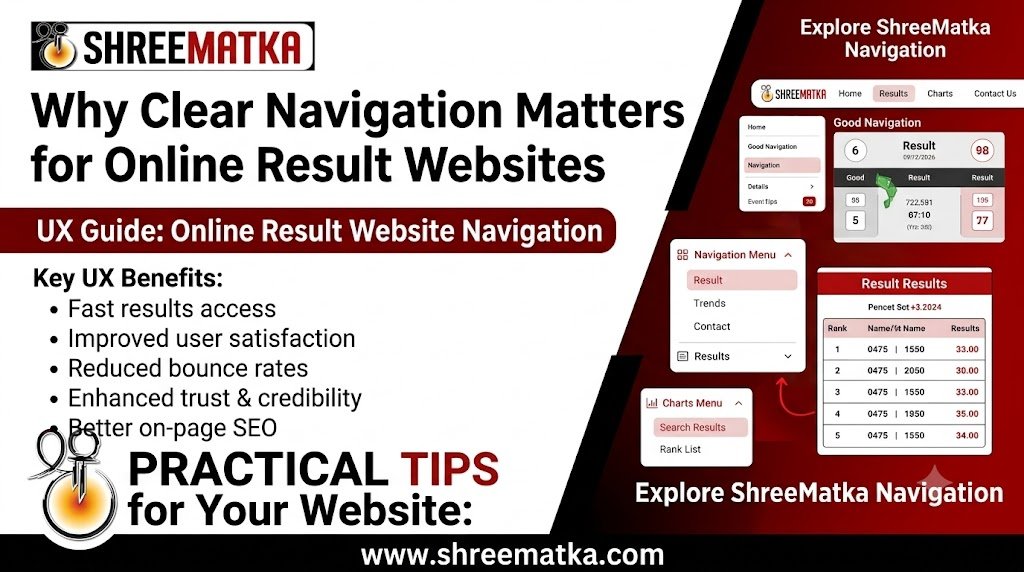
To better understand how website navigation works, let us take a look at the example provided by ShreeMatka. As an online result and informational platform, it features a number of tools to help the user find relevant data without confusion.
The most important sections are organized into top-level menu tabs, including:
- Home – an overview of the website with the most important resources
- Charts – a list of historical records such as Pana, Jodi, and others
- How to Play – a list of informational guides to learn about the basics
- Blog – an informational section featuring UX guides and other articles
In addition to the top-level navigation bar, some of the most important links such as About, Privacy Policy, and Terms & Conditions are located at the bottom of the website to keep the menu uncluttered.
With this organized system, users can easily find the information they are looking for without wasting time browsing irrelevant sections.
Common Navigation Issues & How to Avoid Them
While working on the website navigation, it is also important to avoid some of the most common issues that affect the UX of the platform.
- Overcrowded Menus – avoid putting too many links in the main menu and organize related resources into one section
- Hidden Website Sections – keep the most relevant tools and resources easily accessible
- Inconsistent Page System – avoid changing the location of certain sections or menu items
- Unreadable Mobile Menus – make sure the menu is easily readable and spaced out on smaller screens
- Intrusive Pop-up Windows – avoid using pop-ups interrupting the user’s browsing session
- Broken Internal Links – regularly check links to make sure they are not misplaced or broken
Improving Navigation for Better UX on Result Websites
If you run an online result or informational platform, improving your website navigation is one of the best ways to increase the overall level of UX. Here are some of the essential optimization tips:
- Fewer Top-Level Links – avoid putting more than 6-7 links in the main menu
- Prioritize Important Sections – make sure the most popular resources are located in the first few menu items
- Make It Mobile-Friendly – test how your menu looks on different screen sizes to optimize the responsive design
- Use Descriptive Hyperlink Text – when embedding internal links into the body text, always use descriptive text to indicate where the link will go
- Avoid Unnecessary Footer Links – keep the footer area for additional information and keep the main menu links to the most relevant resources
- Regular Link Audits – periodically check your internal links to make sure they are not broken
Navigation & SEO: Does It Impact Search Rankings?
While having a well-structured menu system and organized internal linking helps improve the overall UX of a resource, it also has a positive impact on SEO. Search engine crawlers follow internal links to discover new resources and better understand the website structure.
However, it should also be noted that website navigation alone will not guarantee better search rankings or higher traffic. Search engines use a complex set of algorithms to sort websites and organize them into the search results according to their relevance to the query.
Also Read: Common Matka Mistakes for Beginners to Avoid
Conclusion
The importance of proper navigation cannot be underestimated. By designing a website with easy-to-find menus, graphics, search tools, categories, and internal links, one can significantly improve one’s ability to navigate the website and avoid confusion.
It is especially important to make sure that the navigation tool is compatible with mobile devices and works well on small screens, where texts and icons are easy to overlook. It is also a good idea to regularly check one’s site for dead links and keep the menu clean and uncluttered.
Overall, the primary purpose of navigation is to ensure that the website’s data is easy to sort and well-accessible. In addition, websites with clean and intuitive navigation are more likely to rank higher in search engine results because they offer a better experience to the users, though improved navigation does not necessarily guarantee higher rankings.
FAQ
1. What Is Online Result Website Navigation?
Online result website navigation refers to the set of design elements that help website visitors find the information they need. It includes menus, search bars, categories, footers, and internal links that assist the user in browsing through different sections and resources.
2. Why Is It Important to Have Clear Navigation on a Results Website?
Website navigation determines how quickly a user will be able to find the exact data they need. With a well-organized system, the user will not get lost browsing irrelevant pages and will be able to locate the needed information faster.
3. How Does Mobile Navigation Affect the User Experience?
Organizing a mobile menu in a way that is easy to read and intuitive helps the user avoid getting lost. As most of the traffic comes from mobile devices, this optimization step is crucial to ensure a positive UX on smaller screens.
4. Are Internal Links Beneficial for Result Websites?
Internal links are a great way to help the user access related resources without getting lost browsing the main menu. They should be used in articles or informational pages to indicate other relevant resources.
5. What Common Issues Should Be Avoided When Organizing Online Result Website Navigation?
Online result websites should avoid using too many links in the main menu, organizing the sections in a confusing manner, and not optimizing the menu for mobile devices.
Disclaimer
Visiting and browsing this website is strictly at your own risk. All information available here is for informational and entertainment purposes only and is based on number calculations. We are not associated or affiliated with any illegal Matka business. We make every effort to follow the rules and regulations of the regions from which the website is accessed. There is a chance the website may be banned in your area; if you continue to use it after that, you alone are responsible for any damage, loss or legal action that may follow. Satta Matka may be illegal in your jurisdiction — please be aware of and comply with your local laws. Gambling can be addictive; players must be 18 or older, and underage gambling is strictly prohibited. If you do not agree with this disclaimer, please leave the website immediately. Copying any content posted on this website is strictly prohibited.