
The Complete History of Satta Matka
Abdul Rahaman is a Full Stack Developer & Marketing Expert specializing in scalable web platforms, digital acquisition, and data analytics.
The Complete History of Satta Matka
Executive Summary (TL;DR)
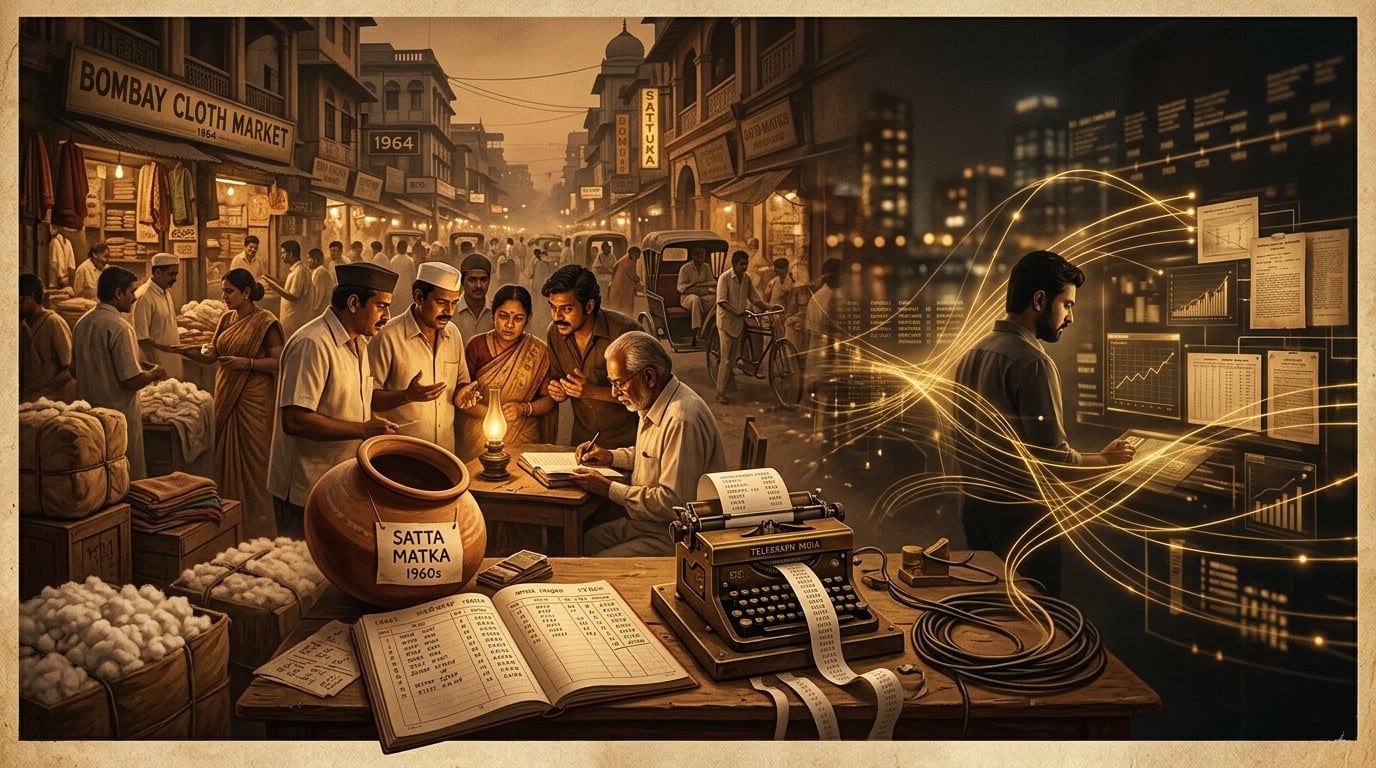
- The Origin: Satta Matka originated in the 1950s around the Bombay Cotton Exchange, where punters speculated on cotton rate teleprinter transmissions from the New York Cotton Exchange.
- The Pioneers: In 1962, farmer-turned-entrepreneur Kalyanji Bhagat launched Worli Matka, drawing slips from an earthen pitcher (Matka). In 1964, Ratan Khatri introduced New Worli Matka, introducing playing-card draws and creating a pan-India betting syndicate.
- Technological Shift: Following aggressive municipal crackdowns in the 1990s, the game migrated from physical back-alley dens to telephone lines, then to SMS, and ultimately to today's cloud-synchronized live results platforms.
- Modern Era: Contemporary services like ShreeMatka serve as digital archival hubs, providing real-time data streaming and mathematical historical records rather than physical wagering.
Few games in modern South Asian history possess a cultural trajectory as dramatic, colorful, and technologically fluid as Satta Matka. What began over six decades ago on the crowded trading floors of colonial-era Bombay as a financial derivative on international raw cotton futures has evolved through multiple iterations: physical clay pitchers, playing cards, telephone syndicates, and today, real-time web applications.
As a full-stack developer and digital acquisition architect, I find the technical evolution of Matka fascinating. Long before modern cloud architecture or distributed databases existed, the organizers of Matka built an ingenious, decentralized data distribution network across India using teleprinters, handwritten ledgers, and trunk telephone calls.
Following our mathematical tutorials on the Complete Beginner's Guide to Satta Matka and Understanding Matka Odds & Probability, this article documents the comprehensive historical journey of Satta Matka from its 1950s origins to the modern digital era.
The Cotton Exchange Era (1950s–1961): Financial Speculation Roots
The genesis of Satta Matka was not an arbitrary number lottery; it was directly connected to global commodities trading.
During the 1950s, Mumbai (then Bombay) was the bustling textile capital of India, famously dubbed the "Manchester of the East." In the commercial hub of Kalbadevi and Sewri, thousands of mill workers and cotton merchants gathered daily around the Bombay Cotton Exchange.
| Transmission Stage | New York Cotton Exchange | Bombay Cotton Exchange |
|---|---|---|
| Generation | Commercial opening and closing spot rates established in NYC. | Received over trans-oceanic teleprinters at Cotton Green. |
| Speculation | International commodity price fluctuations. | Local traders and mill workers wagered on the final fluctuating digits. |
Punters placed wagers on the opening and closing prices of raw cotton as transmitted via commercial teleprinters from the New York Cotton Exchange to Bombay. Wagers were placed on the fluctuating unit numbers of the price index.
The 1961 Market Disruption
In 1961, the New York Cotton Exchange permanently discontinued the practice of publishing and transmitting speculative cotton rate feeds to foreign exchanges in an effort to curb international gambling rings.
Suddenly, an entire ecosystem of thousands of bookmakers, runners, and traders in central Mumbai found themselves without an underlying financial index to speculate upon. Rather than shuttering operations, the market's leading figures improvised a brilliant domestic alternative: generating their own verifiable random numbers.
The Birth of the "Matka": Kalyanji Bhagat & Worli Matka (1962)
The vacuum left by the Cotton Exchange was quickly filled by Kalyanji Bhagat, a Gujarati farmer who migrated to Bombay from Kutch in the 1940s.
| Pioneer & Era | Market Founded | Primary Innovation | Operating Framework |
|---|---|---|---|
| Kalyanji Bhagat (1962) | Kalyan Matka | Introduced the traditional clay pot (Matka) with numbered paper chits. | Operated 7 days a week; designed for Mumbai textile mill laborers. |
| Ratan Khatri (1964) | New Worli Matka | Replaced earthen chits with physical playing cards drawn in public. | Operated 5 days a week; created formalized nationwide syndicates. |
The Earthen Pitcher Mechanism
In 1962, operating out of a grocery store in Worli, Kalyanji Bhagat introduced Worli Matka. To establish trust and random selection, Bhagat wrote numbers from 0 to 9 on chits of paper, deposited them inside a large terracotta clay pitcher (Matka), and drew numbers publicly in front of attendees.
The name stuck: the game became forever known as Matka, while the act of wagering retained the Hindi word Satta.
Key innovations introduced by Kalyanji Bhagat included:
- Mass Accessibility: Lowering minimum wagers to just one rupee, allowing the working-class mill laborers of Girangaon (the Mill District) to participate.
- 7-Day Operational Cycle: Operating daily without rest, creating unprecedented market liquidity.
- The Kalyan Legacy: Bhagat's system laid the foundation for what remains today the single most prominent market in India: Kalyan Matka.
Explore how this daily format operates today in our How to Play Guide.
The Golden Era & The "Matka King": Ratan Khatri (1964–1990s)
While Kalyanji Bhagat created the template, it was a charismatic Sindhi migrant named Ratan Khatri who transformed Matka into a nationwide cultural and financial phenomenon.
Arriving in Bombay as a refugee following the 1947 partition, Khatri initially worked alongside Bhagat before parting ways in 1964 to establish his own independent brand: New Worli Matka.
Ratan Khatri's Systemic Innovations
Ratan Khatri recognized that public confidence in the fairness of the draw was the most critical factor for scale. To eliminate suspicions of weighted paper chits, Khatri introduced major reforms:
- The Playing Card Draw: Rather than drawing slips from a pitcher, Khatri utilized a standard deck of 52 playing cards. A deck with face cards removed was shuffled publicly, and three cards were pulled to establish the Open and Close Pana.
- The 5-Day Business Week: Operating Monday through Friday, aligning with standard financial market schedules.
- The Trunk-Call Syndicate: Khatri set up an underground telecommunication network centered at Zaveri Bazaar. Daily winning numbers were dispatched simultaneously via manual trunk telephone calls to bookmakers in Ahmedabad, Surat, Delhi, Kolkata, and Bangalore within minutes of the draw.
At the peak of his influence during the 1970s and 1980s, Ratan Khatri was crowned the undisputed "Matka King" of India. The daily volume flowing through his network was estimated by contemporary financial journalists to exceed several hundred crore rupees monthly.
Chronological Evolution: From 1960s Bombay to Modern Cloud Services
The transformation of Satta Matka over the past sixty years reflects the broader evolution of technology and telecommunications across India:
| Era | Primary Medium | Draw Mechanism | Market Scope | Key Characteristics |
|---|---|---|---|---|
| 1950–1961 | Teleprinter Cables | New York Cotton Exchange Rates | Bombay local | Commercial financial derivative. |
| 1962–1963 | Clay Pitcher (Matka) | Paper chits drawn from pitcher | Central Mumbai | Inception of Kalyanji Bhagat's format. |
| 1964–1980s | Playing Cards & Trunk Calls | Shuffled card decks in public draws | Pan-India | Ratan Khatri's syndicate era. |
| 1990–2005 | Pagers, Landlines, SMS | Closed syndicate draws | Decentralized | Mill closures; shift to covert phones. |
| 2006–2018 | Early Web & Wap Portals | Automated electronic draws | Digital migration | Emergence of online chart registries. |
| 2019–Present | Real-Time Cloud Apps | Synchronized data streaming | Global Web | High-speed platforms like ShreeMatka. |
The 1990s Transition: Mill Closures, Crackdowns & Decentralization
The golden age of physical Matka dens came to an abrupt end in the late 1980s and 1990s due to two monumental socio-economic shifts:
1. The Great Bombay Textile Strike (1982)
The catastrophic textile strike of 1982 led by Datta Samant caused the permanent closure of dozens of historic textile mills across Girangaon. Over 250,000 mill workers—the core demographic of central Mumbai's Matka economy—lost their livelihoods, dispersing to outlying suburban districts or returning to rural hometowns in Maharashtra and Gujarat.
2. Aggressive Law Enforcement Campaigns
In the mid-1990s, the Mumbai Police initiated extensive crackdowns against physical gambling parlors and illegal bookmaking dens. High-profile raids made running public draw ceremonies impossible.
Faced with severe operational disruption, the syndicates abandoned centralized physical dens. Instead, operations fragmented into small, highly decentralized cells communicating exclusively via pagers, landline phones, and later, early mobile text messaging (SMS).
The 21st Century: The Digital Revolution & Modern Informational Platforms
The arrival of the internet in India, followed by the mid-2010s mobile data revolution (spearheaded by low-cost 4G infrastructure), completely transformed the remnants of the Matka ecosystem.
From Underground Dens to Open Information Hubs
Today, the physical dens of 1970s Worli have disappeared. The modern audience does not rely on word-of-mouth runners or suspicious telephone operators. Instead, users interact with open, highly accessible web portals.
Modern platforms such as ShreeMatka have fundamentally transformed the landscape into an informational, analytical ecosystem:
- Instant Result Synchronization: Rather than waiting hours for telephone relays, live declarations for markets like Kalyan, Milan, and Rajdhani stream across high-performance web APIs within seconds.
- Historical Data Science: Modern platforms catalog comprehensive, verifiable archives. Users can inspect thirty-year Kalyan Jodi Records and multi-year Kalyan Panel Records in interactive, filterable grids.
- Educational Empowerment: Shifting the narrative away from blind superstition toward transparent mathematics, probability distribution models, and responsible digital engagement.
Explore our extensive collection of market records on the centralized Live Matka Charts directory.
The Responsibility Mandate & Historical Perspective
Looking back at the sixty-year history of Satta Matka offers a profound lesson in probability and human psychology. While the folklore surrounding figures like Kalyanji Bhagat and Ratan Khatri remains an intriguing chapter of Mumbai's working-class heritage, historical records also document the financial distress that unmanaged gambling caused to thousands of families.
At ShreeMatka, we believe that understanding history is the best way to develop modern discipline:
- Acknowledge Mathematics Over Myth: The romanticized stories of "guaranteed guessing masters" were marketing myths. As proven in our guide on Matka Odds & Probability, every draw is governed by independent random variables.
- Treat Data as Historical Analytics: Explore charts and records for intellectual pattern observation and cultural curiosity, never as a mechanism for financial recovery or speculation.
- Practice Absolute Digital Discipline: Maintain strict personal boundaries, observe legal standards, and never commit essential financial resources to speculative activities.
Discover more about our editorial philosophy, data architecture, and transparency standards on our About Us page.
Frequently Asked Questions
Who was the original founder of Satta Matka?
Satta Matka was originally founded in 1962 by Kalyanji Bhagat, a Gujarati immigrant who introduced Worli Matka in central Mumbai. Two years later, in 1964, Ratan Khatri introduced New Worli Matka, reforming the draw mechanism with playing cards and expanding the network across India.
Why was the game named "Matka"?
The game was named "Matka" because in its early 1960s format, numbered slips of paper ranging from 0 to 9 were placed inside an authentic terracotta earthen pitcher—known as a Matka in Hindi—from which winning chits were drawn publicly.
How did Satta Matka start with the cotton exchange?
In the 1950s, merchants and laborers in Bombay wagered on the opening and closing rates of raw cotton transmitted via teleprinter from the New York Cotton Exchange. When New York discontinued transmitting these speculative feeds in 1961, local organizers invented a number-drawing system to replace the cotton price index.
What was the difference between Kalyan Matka and Worli Matka?
Kalyan Matka, pioneered by Kalyanji Bhagat, operated seven days a week and accepted smaller wagers suitable for mill workers. New Worli Matka, established by Ratan Khatri, operated five days a week (Monday to Friday) and utilized playing cards instead of paper chits to ensure higher perceived transparency.
How do modern platforms like ShreeMatka differ from historical Matka dens?
Historical Matka dens were physical, unverified bookmaking locations prone to delays, rumors, and operational raids. Modern platforms like ShreeMatka are cloud-synchronized informational websites that provide real-time public draw results, transparent historical chart archives, and educational analysis without physical betting dens.
Disclaimer
Visiting and browsing this website is strictly at your own risk. All information available here is for informational and entertainment purposes only and is based on number calculations. We are not associated or affiliated with any illegal Matka business. We make every effort to follow the rules and regulations of the regions from which the website is accessed. There is a chance the website may be banned in your area; if you continue to use it after that, you alone are responsible for any damage, loss or legal action that may follow. Satta Matka may be illegal in your jurisdiction — please be aware of and comply with your local laws. Gambling can be addictive; players must be 18 or older, and underage gambling is strictly prohibited. If you do not agree with this disclaimer, please leave the website immediately. Copying any content posted on this website is strictly prohibited.