
Regional Variations of Satta Matka Across India
Abdul Rahaman is a Full Stack Developer & Marketing Expert specializing in scalable web platforms, digital acquisition, and data analytics.
Regional Variations of Satta Matka Across India
Executive Summary (TL;DR)
- Geographic Evolution: While Satta Matka was born around Mumbai's 1960s cotton markets, it fractured geographically into distinctly different regional variants across Western, Northern, Eastern, and Southern India.
- Structural Divergence: Western markets (Kalyan, Milan) utilize classical 3-digit Panel (Pana) sum mechanics; Northern markets (Gali, Deshawar) focus on single-stage Jodi/Haruf draws; Eastern markets (Kolkata Fatafat) operate rapid multi-session "Bazi" formats.
- Terminology & Nuances: Terms like Andar/Bahar Haruf, Bazi, Pana, and Open/Close vary widely by territory, reflecting unique local cultural adaptations.
- Digital Centralization: Modern platforms like ShreeMatka unify these disparate regional data feeds into standardized, low-latency historical archives and live results dashboards.
When people hear the term Satta Matka, they often envision a single uniform lottery system. In reality, the landscape of Indian numerical markets is as diverse, culturally nuanced, and geographically fragmented as India itself.
Over the course of six decades, the original format pioneered by Kalyanji Bhagat and Ratan Khatri in central Bombay (explored in our chronicle on The Complete History of Satta Matka) migrated outward into distinct state and regional subcultures. Each territory altered the draw frequency, modified mathematical rules, and invented local terminology to suit its audience.
As a full-stack engineer and digital acquisition specialist, I find the data architectures of these decentralized regional networks fascinating. In previous guides, we explored the Complete Beginner's Guide to Satta Matka, analyzed How to Read Matka Charts Like a Pro, and detailed game-specific strategies in our Kalyan Matka Guide.
In this comparative geographic study, we analyze the major regional variations of Satta Matka across India: comparing the classical Western markets, the Northern Haruf networks, Eastern rapid-fire lotteries, and emerging Southern circuits, and exploring how ShreeMatka harmonizes these feeds into a unified digital experience.
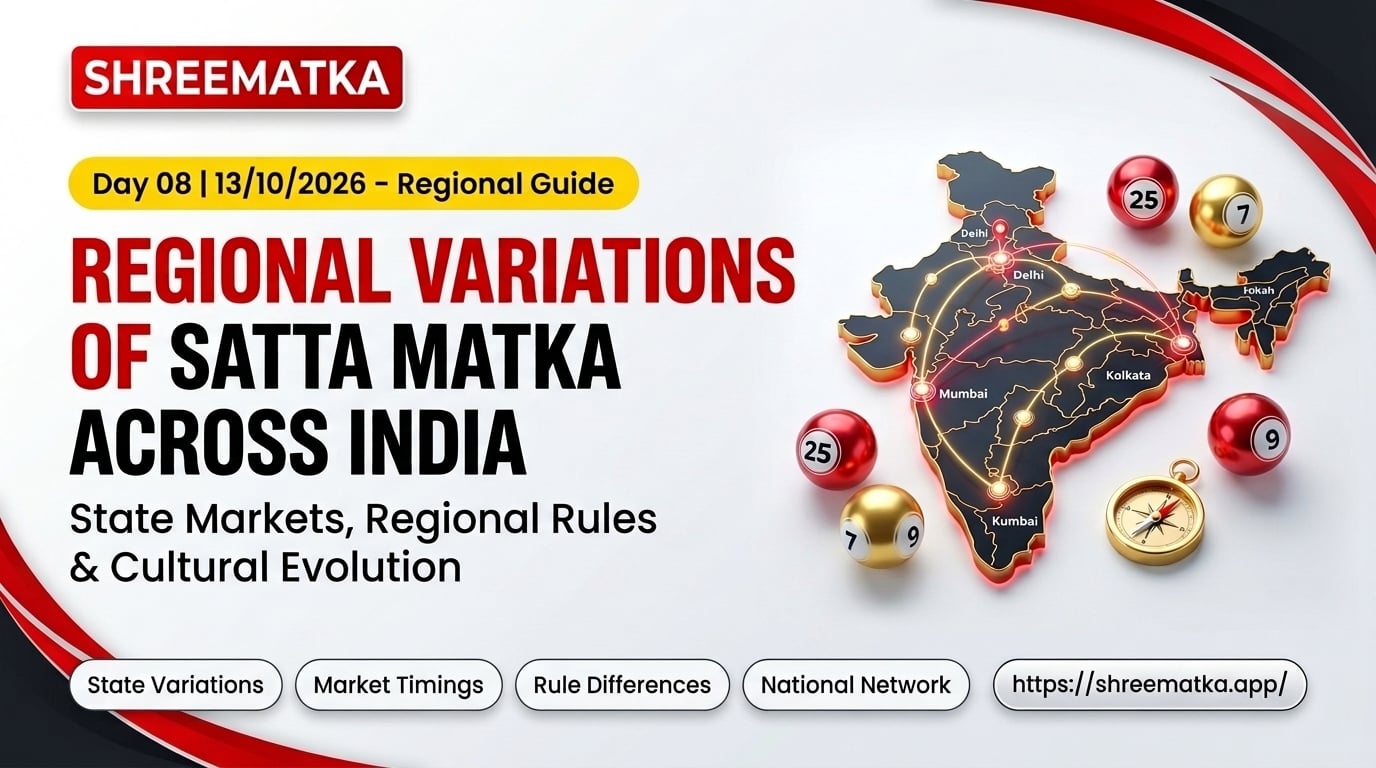
The Geographic Map of Indian Matka Formats
Across India's states and territories, number games generally fall into four major geographic clusters:
| Geographic Region | Primary Market Bazaars | Signature Draw Architecture |
|---|---|---|
| Western India (Mumbai/Gujarat) | Kalyan, Milan Day/Night, Time Bazar, Ratan | Two-stage Open and Close draws (3-Digit Panel + Single Ank). |
| Northern India (Delhi/NCR/UP) | Gali, Deshawar, Faridabad, Ghaziabad | Single 2-digit draw evaluated via Andar/Bahar Haruf brackets. |
| Eastern India (West Bengal) | Kolkata Fatafat | Multi-session rapid-fire draws (8 consecutive daily Bazis). |
| Southern India (Karnataka/AP) | Karnataka Day/Night, Andhra, Balaji | Staggered regional schedules utilizing classical Pana matrices. |
Let us examine each regional format in detail.
1. Western India: The Classical Hub (Maharashtra & Gujarat)
Western India—particularly the Mumbai–Ahmedabad–Surat corridor—remains the historical birthplace and gold standard of traditional Matka.
The Mechanics of the Western Format
Markets in this region (such as Kalyan Matka, Milan Day/Night, and Time Bazar) follow the strict mathematical framework developed in the 1960s:
- Two-Stage Daily Resolution: A daytime or afternoon Open session, followed by an evening Close session.
- The 3-Digit Panel Formula: Three ascending digits (1-9) are drawn, summed, and the unit digit is retained as the single Ank (e.g., 1 + 4 + 9 = 14 → 4).
- The 2-Digit Jodi Formulation: The Open Ank and Close Ank join together to create the daily pair (00-99).
- Rich Payout Structures: Features complex multi-tier categories including Single Pana (120 unique combinations), Double Pana (90 combinations), Triple Pana (10 jackpot combinations), and Sangam formats.
Western markets maintain deep multi-decade archives. For example, you can review thirty years of uninterrupted ledger data on the Kalyan Jodi Chart and the Kalyan Pana Chart.
2. Northern India: The Delhi & NCR System (Gali, Deshawar, Faridabad)
As Matka expanded into Delhi, Haryana, Uttar Pradesh, and Punjab during the 1980s, organizers modified the game to fit regional cultural habits, creating what is popularly termed the Delhi Bazaar or Disawar Network.
Key Northern Innovations
- Absence of 3-Digit Panas: Unlike the Mumbai market, Northern games generally bypass the 3-digit Pana sum calculation. The draw focuses directly on a single, definitive two-digit Jodi (00–99).
- The "Haruf" System (हरूफ): Instead of calculating an Ank from panel sums, Northern players bet on the individual digits comprising the Jodi:
- Andar Haruf (अंदर हरूफ): The tens-place digit (inside digit).
- Bahar Haruf (बाहर हरूफ): The units-place digit (outside digit).
- Example: If the winning number is
58, the Andar Haruf is5and the Bahar Haruf is8.
- Dawn Declarations (Deshawar): The legendary Deshawar market famously declares its result in the early hours of dawn (typically around 05:00 AM), allowing agricultural and wholesale trading communities to inspect winning numbers before sunrise.
- Staggered Evening Chain: Markets run in rapid sequence: Faridabad (06:00 PM) → Ghaziabad (08:00 PM) → Gali (11:00 PM) → Deshawar (05:00 AM).
3. Eastern India: The Rapid-Fire "Fatafat" Format (West Bengal)
In Eastern India—specifically Kolkata and neighboring districts—the market evolved into an entirely different high-frequency lottery known as Kolkata Fatafat.
| Session Number | Scheduled Timing | Session Number | Scheduled Timing |
|---|---|---|---|
| Bazi 1 | 10:00 AM | Bazi 5 | 04:00 PM |
| Bazi 2 | 11:30 AM | Bazi 6 | 05:30 PM |
| Bazi 3 | 01:00 PM | Bazi 7 | 07:00 PM |
| Bazi 4 | 02:30 PM | Bazi 8 | 08:30 PM (Night Conclusion) |
The "Bazi" Mechanics
- 8 Rounds Daily: While Western markets declare twice per day (Open and Close), Kolkata Fatafat conducts 8 rounds ("Bazis") every day from morning until evening, with draws scheduled every 90 minutes.
- Fast-Paced Engagement: Players bet on single digits or 3-digit panels on a round-by-round basis, receiving immediate feedback within an hour and a half.
- Urban Working-Class Demographics: Popularized among local transport operators, small shopkeepers, and street vendors seeking quick micro-turnover rather than full-day waiting periods.
4. Southern & Central India: State Circuits (Karnataka & Andhra)
Southern India historically relied on government lotteries (such as Kerala State Lotteries). However, numerical speculative networks established strong localized presence in Karnataka, Andhra Pradesh, and Telangana, creating dedicated regional bazaars.
Characteristics of Southern Bazaars
- Specialized Schedules: Bazaars such as Karnataka Day, Andhra Morning, Andhra Day, Andhra Night, and Balaji run on calibrated regional timelines that avoid overlapping with peak Kalyan market congestion.
- Hybrid Rules: Most Southern games follow the classical Mumbai 3-digit Panel framework rather than the Northern Haruf model, maintaining high compatibility with standardized Jodi Charts and Panel Charts.
- Digital Affinity: Users across Bengaluru, Hyderabad, and Vijayawada were among the earliest adopters of mobile-first result aggregators like ShreeMatka, prioritizing crisp UI and instant notifications.
Regional Variations: Side-by-Side Comparison
The table below contrasts the four major regional formats across their operational characteristics:
| Regional Zone | Representative Markets | Draw Frequency | Core Mechanics | Key Terminology | Primary Audience |
|---|---|---|---|---|---|
| Western India | Kalyan, Milan Day/Night, Time Bazar, Main Ratan | 2 sessions daily (Open & Close) | 3-digit Panel sum → Ank → Combined Jodi | Open, Close, Pana, Jodi, Sangam, Red Bracket | Maharashtra, Gujarat, Goa, national following |
| Northern India | Gali, Deshawar, Faridabad, Ghaziabad | 1 draw per market daily | Direct 2-digit Jodi without panel sum | Haruf (Andar / Bahar), Jodi, Disawar | Delhi, UP, Haryana, Punjab, Rajasthan |
| Eastern India | Kolkata Fatafat | 8 rounds daily (every 90 mins) | Single digit & 3-digit panel per round | Bazi, Fatafat, Patti | West Bengal, urban Kolkata |
| Southern India | Karnataka Day, Andhra Day/Night, Sita Day, Balaji | 2 sessions daily | Standardized Mumbai Panel framework | Open Pana, Close Pana, Jodi | Karnataka, Andhra Pradesh, Telangana |
To review general betting formats and rates across all formats, visit our How to Play Guide.
How Digital Platforms Unify Fragmented Regional Feeds
Historically, discovering results from another state was exceedingly difficult. A punter in Delhi tracking Kalyan had to rely on long-distance trunk calls, while someone in Kolkata following Mumbai Night depended on delayed morning newspaper inserts.
The advent of cloud-synchronized data platforms has permanently dissolved these regional silos:
- Normalized Data Schemas: On ShreeMatka, diverse regional feeds—from Mumbai's Kalyan Panel Archives to Southern Andhra Jodi Charts—are mapped into clean, standardized tabular formats.
- Zero-Latency Web APIs: Real-time webhooks ingest declarations the moment local officials publish numbers, broadcasting updates across India in milliseconds.
- Multi-Language Accessibility: Platforms bridge linguistic divides by providing intuitive numerical navigation requiring minimal English or Hindi literacy.
Explore the complete national directory on our Live Matka Charts page.
Responsible Gaming: Universal Principles Across All Regions
Regardless of whether a market runs in Mumbai, Delhi, Kolkata, or Bengaluru, the mathematical laws governing discrete probability remain identical:
- No Regional "Secrets": There are no regional calculation tricks or geographical formulas that override the laws of probability. As detailed in our guide on Matka Odds & Probability, every single draw is an independent random event.
- Strict Budget Discipline: Adhere to the principles outlined in our Responsible Gambling Practices Guide. Never risk essential household funds on speculative numbers.
- Avoid Unofficial Operators: Stick to verified public data hubs like ShreeMatka for transparent, unmanipulated historical records.
Learn more about our platform ethics, data governance, and editorial policy on the About Us page.
Frequently Asked Questions
What is the main difference between Mumbai Matka and Delhi Matka?
Mumbai Matka (e.g., Kalyan, Milan) uses a two-stage draw mechanism where 3-digit panels are drawn and summed to produce single Anks, which combine into a Jodi. Delhi Matka (e.g., Gali, Deshawar) typically draws a single 2-digit number directly and features the "Haruf" betting system (Andar and Bahar digits) without 3-digit panel sums.
What is Kolkata Fatafat and how is it different?
Kolkata Fatafat is a rapid-fire regional lottery in West Bengal that conducts 8 draws per day (called Bazis) approximately every 90 minutes from morning to night, unlike traditional Mumbai markets which conduct only two draws per day (Open and Close).
What does Andar and Bahar Haruf mean in Northern markets?
In Northern Indian markets like Gali and Deshawar, Haruf refers to a single digit of the winning 2-digit Jodi. Andar Haruf is the inside (tens) digit, while Bahar Haruf is the outside (units) digit. For example, in result 47, 4 is Andar and 7 is Bahar.
Why do Southern markets like Karnataka and Andhra follow Mumbai rules?
Southern markets were established during the modern expansion of Matka and adopted the well-documented, standardized 3-digit Panel (Pana) framework of Mumbai's Kalyanji Bhagat system to maintain compatibility with established chart analysis tools and national networks.
Can I check results for all regional Indian Matka markets on ShreeMatka?
Yes. ShreeMatka serves as a unified national informational hub, delivering real-time draw declarations, verified panel records, and comprehensive historical archives for major Western, Southern, and national markets in one fast, mobile-friendly interface.
Disclaimer
Visiting and browsing this website is strictly at your own risk. All information available here is for informational and entertainment purposes only and is based on number calculations. We are not associated or affiliated with any illegal Matka business. We make every effort to follow the rules and regulations of the regions from which the website is accessed. There is a chance the website may be banned in your area; if you continue to use it after that, you alone are responsible for any damage, loss or legal action that may follow. Satta Matka may be illegal in your jurisdiction — please be aware of and comply with your local laws. Gambling can be addictive; players must be 18 or older, and underage gambling is strictly prohibited. If you do not agree with this disclaimer, please leave the website immediately. Copying any content posted on this website is strictly prohibited.